
Category: General
Comparison Shopping Engines: How They Work and Which Ones Matter
What a comparison shopping engine is, how offers get matched and ranked, which engines matter by region, and how retailers use the same data to track competitors.
Table of Contents9
What is a comparison shopping engine?
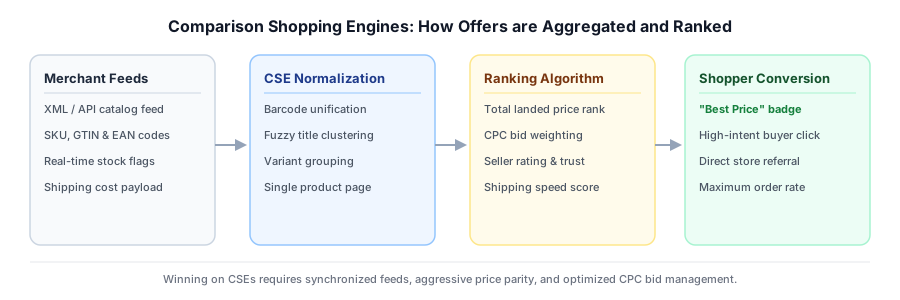
A comparison shopping engine (CSE) is a website that collects product offers from many retailers and displays them side by side so a shopper can compare price, availability and seller reputation for the same item. Retailers submit a product feed; the engine matches offers to a single product page and ranks them. Most engines are paid per click.
Google Shopping is the largest, but the category is far broader — and in several European markets a regional engine sends more qualified traffic than Google does.
How does a comparison shopping engine work?
Four stages, and each one can break independently:
- Feed submission. The retailer uploads a structured product feed — title, description, price, availability, GTIN/MPN, image, shipping, landing page URL — usually as XML or CSV on a schedule.
- Matching. The engine resolves incoming offers to its own catalogue so twenty retailers selling one washing machine appear on one product page. This is the same product matching problem retailers face internally, solved from the other side.
- Ranking. Offers are ordered using a mix of price, bid, feed completeness, click-through history, seller rating and delivery terms. Price alone almost never decides it.
- Click-out and billing. The shopper clicks through to the retailer's site. The retailer pays per click, per category, with a bid that can usually be adjusted at product level.
The failure most retailers hit is at the matching stage: an offer that fails to match ends up on an orphan page nobody visits, and no bid increase can rescue it.
Which comparison shopping engines matter?
The landscape is regional. A short, non-exhaustive map:
- Global / multi-market: Google Shopping, Kelkoo, Twenga, Connexity (Shopzilla, Bizrate).
- DACH: idealo, Geizhals, billiger.de, guenstiger.de, Check24.
- UK & Nordics: PriceRunner, Kelkoo, Google Shopping.
- Southern Europe: Trovaprezzi (Italy), Skroutz (Greece), Idealo.es.
- Central & Eastern Europe: Ceneo (Poland), Heureka (Czechia, Slovakia), Árukereső (Hungary).
- Turkey: Cimri, Akakçe, Epey.
There is also an EU-specific layer worth knowing about. Following the European Commission's Google Shopping decision, Google operates a Comparison Shopping Service (CSS) programme: independent CSS partners can place shopping ads on Google's results pages, often at a lower effective cost than bidding through a standard Merchant Center setup. If you sell in the EU and have never evaluated a CSS partner, that is usually the cheapest available efficiency gain.
How is CSE ranking actually decided?
Retailers assume the cheapest offer wins. It doesn't. The signals that consistently move position:
- Price relative to the other offers on the page — not absolute price, and usually not needing to be lowest. Being within a couple of percent of the leader captures most of the available clicks.
- Bid, where the engine is CPC-based, adjustable per category or product.
- Feed completeness and freshness. Missing GTINs, stale prices and empty attributes suppress visibility regardless of bid.
- Availability accuracy. Engines demote sellers whose "in stock" claims produce out-of-stock landing pages.
- Seller rating and delivery terms. Shipping cost and delivery window are shown next to price and materially change click behaviour.
- Landing-page consistency. A price mismatch between feed and landing page is the single fastest way to get an offer suppressed or an account suspended.
Why product data decides CSE performance
Every engine is a matching machine, and matching runs on your feed. In practice the recurring problems are mundane:
- Titles written for shoppers rather than for parsing — brand and model missing, marketing adjectives up front.
- Missing or wrong GTIN/EAN, which forces the engine to fall back on fuzzy text matching.
- Variant handling: colour and size collapsed into one offer, or split into fifty near-duplicates.
- Currency, VAT and shipping expressed inconsistently across markets.
- Update frequency too low, so promotional prices reach the engine after the promotion ends.
Fixing the feed usually beats raising the bid. It is also cheaper.
How retailers use CSE data in the other direction
Comparison engines are not only an acquisition channel — they are the densest public source of competitor pricing that exists, because competitors publish their prices there voluntarily and in a structured form.
Retail and pricing teams use that in three ways:
- Price positioning. Where do we sit on the offer list for our top SKUs, and how often are we in the top three?
- Assortment intelligence. Which competitors carry which products, and at what price — including sellers you did not know were in your category.
- Promotion detection. Sharp movement on a comparison page is often the earliest visible signal of a competitor promotion, ahead of the retailer's own site cache.
If you want that view without running the collection yourself, our competitor pricing datasets and e-commerce scraper API deliver comparison-engine and retailer offers as normalised feeds. The mechanics of collecting them are covered in price scraping.
Comparison shopping engine or marketplace?
They are often confused, and the difference is who owns the transaction:
- On a comparison engine the shopper leaves for your site. You keep the checkout, the customer data and the relationship, and you pay per click.
- On a marketplace the transaction happens on their platform. You pay commission on the sale, and the customer is largely theirs.
Most retailers need both, but they need different data hygiene. Marketplaces punish poor content with lost buy-box share; comparison engines punish it with invisibility.
Where retailers go wrong on comparison engines
- One feed for every engine. Attribute requirements and category taxonomies differ; a lowest-common-denominator feed underperforms everywhere.
- Flat bids across the catalogue. Margin varies by product by a factor of ten; bids rarely do.
- Ignoring shipping. On a page where every price is within 2%, delivery cost is the differentiator.
- No monitoring of your own position. Bidding without knowing where you land on the offer list is guessing with a budget attached.
- Treating the engine as a price war. Continuously matching the lowest offer trains the market to expect it. Competitor price monitoring is what lets you respond selectively instead.
Getting started
Pick the two engines that matter in your largest market, fix the feed for those two specifically, and instrument your own position before you touch bids. Then decide — with data — whether the third engine is worth the operational cost.
If the objective is competitive visibility rather than acquisition, start with competitor pricing datasets; if it is understanding how those numbers should change your prices, see price intelligence.
Where this fits in the platform

Strategic Lead, Senkrondata
Kerem leads strategy at Senkrondata, with years of experience in data engineering and market analysis.
Contact Us
Leave your email address for a detailed demo or overview session, and we will get back to you shortly.