
Category: Analytics
What Is Price Intelligence? Data, Metrics and Use Cases
Price intelligence explained: the 4 data inputs it runs on, the 6 metrics that matter, and how it differs from price monitoring and dynamic pricing.
Table of Contents8
What is price intelligence?
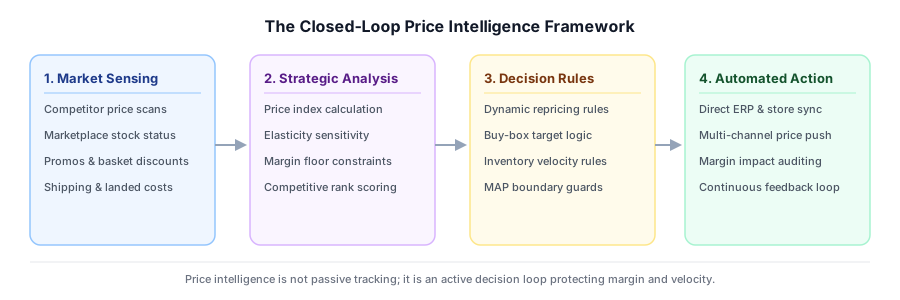
Price intelligence is the practice of collecting competitor and market pricing data, normalising it so it can be compared to your own catalogue, and turning it into pricing decisions. It covers the whole chain: collection, product matching, metrics, and the commercial rules that decide when a number should change a price.
The word doing the work is *intelligence*. Anyone can gather prices. The discipline is in making prices comparable and then acting on them consistently.
Price intelligence, price monitoring and dynamic pricing
These three get used interchangeably in vendor marketing, which is unhelpful because they describe different scopes:
- Price monitoring is collection and observation. What are competitors charging, where, and since when?
- Price intelligence adds interpretation. Given our costs, margins, stock position and market role, what does that observation mean for us?
- Dynamic pricing is execution. Rules or models that change prices automatically based on that interpretation.
You can run monitoring without intelligence — many teams do, and they end up with dashboards nobody opens. You cannot run credible dynamic pricing without intelligence underneath it, because automation applied to badly matched data changes the wrong prices faster.
What data does price intelligence run on?
Four inputs, in descending order of how often they are neglected:
- Competitor offers. Price, stock status, seller identity, shipping cost and promotion state, captured per marketplace and per country, with a timestamp. Shipping and stock are the fields teams skip and later discover they needed.
- Your own catalogue and costs. Cost of goods, target margin, elasticity assumptions, stock cover. Without these, competitor data can only tell you that you are expensive — not whether that is a problem.
- Product identity. The mapping between your SKU and every competitor offer for the same item. This is product matching, and it is where the quality of everything downstream is set.
- History. Yesterday's price is data; a year of prices is a signal. Repricing cadence, promotional patterns and seasonal behaviour only become visible with history.
Two of those you already own. The other two are what a data provider supplies — our competitor pricing datasets and monitoring API deliver normalised, timestamped offers across 23 countries and 500M+ rows, backed by a 97.2% data accuracy SLA.
Which price intelligence metrics matter?
A small set of metrics carries most of the value:
- Price index (CPI). Your price divided by a competitor's price, times 100. Below 100 means you are cheaper. Reported per competitor, per category, and weighted by revenue rather than SKU count — an unweighted index is dominated by the tail nobody buys.
- Price position. Your rank among available offers for a product. Cheaper reads well on a slide; position is what the customer actually sees on a comparison page.
- Match rate. The share of your catalogue for which a confident competitor match exists. If this is 40%, every other metric describes 40% of your business.
- Coverage. How many relevant competitors and marketplaces you actually observe, per category.
- Freshness. Median age of the price data behind a decision. A 24-hour-old price in fast-moving electronics is a historical document.
- Reaction time. How long between a competitor move and your response — the number that shows whether the function is operational or reporting.
The first metric to instrument is match rate, because it silently bounds all the others.
What is price intelligence actually used for?
- Setting and defending price position. Deciding, per category, whether you are the cheapest, at parity, or deliberately above — and being able to prove where you sit.
- Responding to promotions selectively. Matching every discount destroys margin. Intelligence identifies the products where a competitor's move actually moves your volume.
- Protecting margin on the long tail. Most catalogues have thousands of products nobody compares. Competitive data shows which ones can carry a higher price.
- Assortment and gap analysis. What competitors stock that you don't, and at what price.
- Product and range decisions. Sustained pricing patterns across a category reveal where margin structurally exists before you commit to launching into it.
- Channel and reseller control. The same feed supports MAP monitoring when you are the brand rather than the retailer.
How do you build the function?
The order matters more than the tooling:
- Define the competitive set per category. Not company-wide. The competitors that matter in small appliances are not the ones that matter in cosmetics.
- Fix identity before analytics. Get match rate and match confidence to a level you would defend in a meeting. Everything else is premature until then.
- Choose one metric to run the business on. Usually revenue-weighted price index by category. Add others later.
- Write the rules down. "Match on key value items, hold on exclusives, ignore unauthorised sellers" is a policy. Without it, every price becomes a debate.
- Instrument reaction time. A function that reports weekly on a market that moves daily is a reporting function, not a pricing one.
- Then automate. Rules first, models second, and only where the data density supports it.
Where price intelligence fails
- Matching treated as a solved problem. Fuzzy title matching produces confident nonsense: a 128 GB phone compared to a 256 GB one, a two-pack compared to a single.
- Averaging across competitors. A mean competitor price hides the only fact that matters — who is cheapest and by how much.
- Ignoring shipping and availability. A cheaper price that ships in three weeks is not a cheaper offer, and an out-of-stock competitor is not a constraint.
- Unweighted indices. SKU-weighted metrics let the dead tail overwhelm the products that pay the bills.
- Data with no decision attached. If nobody has agreed in advance what a CPI of 104 should trigger, the number is trivia.
Getting started
If you have no competitive data yet, start with one category, the five competitors that matter in it, and daily collection. One category done properly teaches you more than a catalogue-wide rollout that nobody trusts.
Our AI price intelligence platform covers matching, metrics and alerting on top of our own collection; if you already have a pricing engine and only need the feed, the price monitoring API and AI-ready datasets supply it directly.
For the collection layer underneath all of this, see competitor price monitoring and price scraping. Market-level benchmarks live in our e-commerce pricing statistics.
Where this fits in the platform

Strategic Lead, Senkrondata
Kerem leads strategy at Senkrondata, with years of experience in data engineering and market analysis.
Contact Us
Leave your email address for a detailed demo or overview session, and we will get back to you shortly.