
Category: Analytics
Hotel Price History: What Rate Data Over Time Reveals
A single hotel rate tells you almost nothing. What a price history reveals, how to check one, and what quietly breaks a rate series.
Table of Contents6
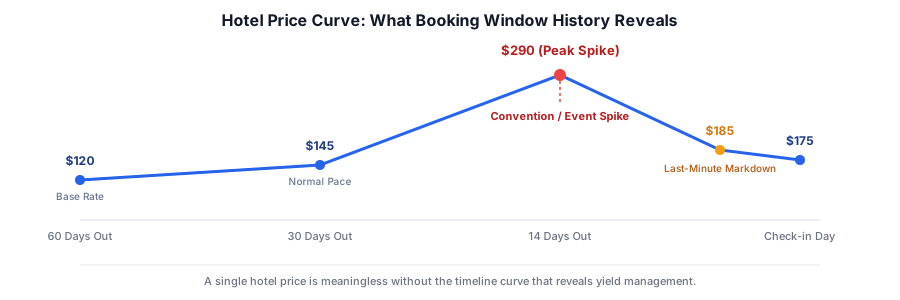
A hotel rate on its own is a number without a reference point. €180 a night is high or low depending on what the same room cost last Tuesday, what it costs at the property across the street, and whether the city is hosting a conference that week. One observation is a number. A series of observations is a behaviour.
That is the whole argument for tracking hotel price history: the value is not in the current rate, which anyone can see, but in the shape of the rates that came before it.
What a rate series actually shows
Three things become visible once you have a timeline and stop looking at snapshots.
Seasonality that is specific, not general. Everyone knows August is expensive on the coast. A price history tells you how expensive, how early the climb starts, and whether it starts earlier this year than last. That is the difference between a hunch and a booking window.
Event response. Rates around a stadium move differently on match nights. Rates near a convention centre move when the calendar fills. Without history you see a high price and assume the property is expensive; with history you see a property that prices flat all year and spikes eleven times.
Whether a discount is real. A rate marked down from a list price nobody was ever charged is not a discount, it is a layout. A price series settles the question without argument — either the room traded at the higher number or it did not.
How to check hotel price history
For a single stay, the practical options are limited. Some booking platforms show a rough price trend on the property page, and metasearch sites occasionally surface a "prices are lower than usual" badge. Both are useful and both share the same two limits: the window is short, and the comparison is to an average you cannot inspect.
If you want to check hotel price history for one trip, that is usually enough. The moment the question becomes comparative — across properties, across markets, across a season — manual checking stops working. Ten properties over ninety days is nine hundred observations, and they have to be taken at the same time of day, for the same occupancy, under the same cancellation terms, or they are not comparable at all.
What quietly breaks a rate series
This is where most hotel price tracking goes wrong, and the failures are undramatic enough to go unnoticed for months.
Room type drift. "Double room" at the same property can mean city view on one date and courtyard on another. Compare across dates without pinning the room category and you are measuring the room, not the price.
Cancellation terms. A flexible rate and a non-refundable rate for the same night can differ by twenty percent. A series that mixes them shows volatility that never happened.
Board and taxes. Breakfast included, city tax shown or hidden, VAT displayed differently by market. Two rates that look like €180 and €205 can be the same commercial offer described two ways.
Currency and residency. The same room quoted in different currencies, or to a visitor whose IP places them in another country, is not always the same number. Currency conversion at collection time, not at read time, is the only version that stays comparable.
Availability as a hidden variable. A rate that disappears is not a rate that went up. A series that silently drops sold-out dates reads as stable when the property was actually full — the same reason out-of-stock is a signal too in retail.
None of these are exotic. They are the normal state of hotel distribution, and a rate history that does not control for them is a chart of its own collection errors.
From one property to a rate dataset
Revenue managers, OTAs and travel platforms need the same series at a different scale: every competitor property, every stay date in a rolling window, every channel the room is sold through. At that point historical hotel price data stops being something you check and becomes something you store — a dataset with a schema, a collection schedule, and a definition of what counts as the same room.
The engineering questions are the ones any structured collection faces: what identifies a comparable unit, how often the window refreshes, and what happens when a source changes its layout. Getting the identity question right matters most, because a series that silently swaps what it measures is worse than no series — it produces confident charts of nothing.
Old data is the failure mode
A price history has one property that separates it from most datasets: it is only useful if it is continuous. A gap in a retail price feed costs you one day's comparison. A gap in a rate series during the week demand turned costs you the pattern the whole series existed to capture.
This is why freshness belongs in the contract rather than in the roadmap — the argument we make at length in data freshness is an SLA. A rate that was correct on Tuesday and is served on Friday as current is not stale data in the harmless sense. It is a wrong answer wearing the clothes of a right one.
Where this lands
For a single booking, a price trend badge is enough. For pricing decisions across a portfolio, you need a rate series you control: defined room identity, consistent terms, timestamped observations, and a freshness guarantee you can point at.
That is the problem our hotel price tracker is built around, and the same data layer that supports the wider travel and hospitality work. The rate is the easy part. The series is the product.
Where this fits in the platform
Price Intelligence & Data Engineering
Emre writes about the machinery behind competitor price data: product matching, normalization, collection at scale and the analytics layer on top.
Contact Us
Leave your email address for a detailed demo or overview session, and we will get back to you shortly.