Category: Analytics
"Out of Stock" Is a Signal Too: Why Availability Tracking Is as Valuable as Price
Why does out-of-stock tracking matter? A competitor’s stock-out is an opportunity — if you notice it. How Senkrondata tracks stock alongside price.
Table of Contents5
A competitor ran out of stock on their bestselling product. That information doesn't look as dramatic as a price change — there's no red number on screen, just a quiet "out of stock" tag. But that quiet tag, read correctly, can open a door to an opportunity bigger than price: you're there when the competitor isn't.
Availability tracking is a signal that lives in the shadow of price monitoring but is worth just as much.
Why stock status is a separate field
On any given observation, price and stock status are recorded at the same time but separately. The reason is simple: a product's price can stay fixed while stock status changes (or the other way around), and mixing the two leads to wrong conclusions. Comparing an out-of-stock product's "old" price to a current price, for instance, is misleading — that's now a number nobody can actually pay.
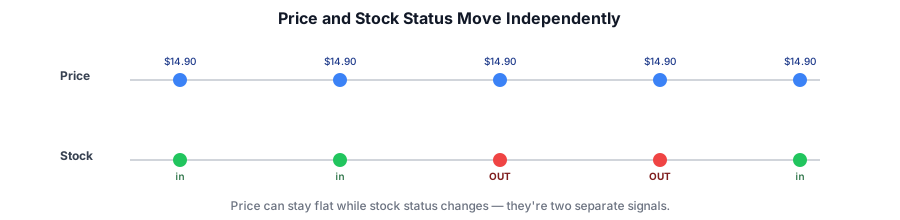
When stock status itself is tracked over time (the same price-history logic applies here), the question "since when has this been out of stock?" becomes answerable.
The opportunity windows an out-of-stock event opens
- Demand transfer. While a competitor is out of stock, a customer searching for that product goes elsewhere. Being in stock and visible at that moment lets you capture demand that would otherwise go to them.
- Pricing room. Price comparison temporarily loses meaning while a competitor is out of stock — that can be a window where you operate under less price pressure for a while.
- A supply chain signal. A product going out of stock frequently and for long stretches is an indirect indicator that the competitor is having supply issues in that category.
- Category-level patterns. A specific category/brand staying chronically out of stock at the competitor can be a signal to invest more in your own stock in that area.

Availability as part of the digital shelf
Availability isn't a standalone metric — it's a component of digital shelf visibility: no matter how well a product is positioned, if it's out of stock, that position is worth zero. That's why in shelf analytics, stock status is one of three signals that need to be read together with ranking and price.
The principles that keep it trustworthy
- Stock status is recorded independently of price. Merging the two into one field lets one mask the other.
- "Out of stock" is an event, not noise. It can be a brief blip (a few hours) or a persistent signal (weeks) — duration is what tells them apart.
- The opportunity window is time-sensitive. The value of an out-of-stock signal depends on how quickly it's noticed; an opportunity noticed late is an opportunity missed.
The bottom line
"Out of stock" looks like a small detail on screen, but it's an actionable signal just as much as a competitor's price. Tracking it alongside price and visibility opens a window to notice — and act on — a competitor's weak moment.
If you want to track competitor stock status alongside price, talk to the Senkrondata team.
Where this fits in the platform
Price Intelligence & Data Engineering
Emre writes about the machinery behind competitor price data: product matching, normalization, collection at scale and the analytics layer on top.
Contact Us
Leave your email address for a detailed demo or overview session, and we will get back to you shortly.