
Category: Scraping
How Mobile App Scraping Actually Works
App scraping is not screen reading. How version drift, location and language parameters, and the identity problem shape the collection.
Table of Contents8
Mobile app scraping is not reading text off a screen. The app is itself a client: every price, list and delivery estimate it shows was requested from a service and then drawn. The job of collection is not to imitate the screen but to understand the response.
That distinction decides everything downstream. An approach that reads the screen breaks whenever the interface changes and is limited to what the interface displays. An approach that works at the service layer also reaches fields never rendered at all — stock counts, campaign identifiers, ranking scores — which are usually the fields that drive the decision.
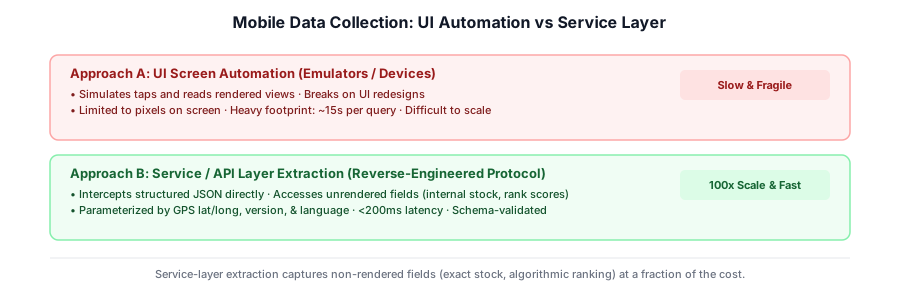
Two approaches and what they cost
Interface automation. Run the app on a real or virtual device and walk the screens. Intuitive to set up, expensive to scale: every observation costs device-seconds, one redesign breaks the whole flow, and the data is only ever as rich as what was displayed.
The service layer. Understand the interface the app talks to and take the data from there, already structured. Harder to set up, incomparably cheaper to scale, and typed from the start.
Real systems use both. The service layer carries the volume; interface automation is kept for verification — because what you ultimately want to measure is the number the user sees, and only the screen can confirm it.
The contract changes and nobody announces it
In web scraping, a layout change usually breaks loudly: a selector misses, a field comes back empty, an error counter climbs. On the app side, breakage is quiet. A field gets renamed, a campaign type returns under a new code, a list starts defaulting to fewer items — and collection keeps running, just measuring something else now.
The only antidote is schema validation: checking field by field that each response carries the expected fields, types and plausible ranges. A price of zero is not an error, it is a valid number; what makes it an error is that the field returned fifteen yesterday. We described the same discipline for collection engines in why one scraper is not enough.
App versions layer onto this problem. Some users stay on older builds, the service answers both, and two versions can return different answers to the same question. Which version your collection represents has to be a written choice rather than an accident.
Location, language and platform are parameters
On the app side the same request, sent with different coordinates, a different language or a different platform, returns a different response. That is not a detail — it is the definition of coverage.
So "we track that app" is an incomplete sentence. Coverage is the set of app, region and language pairs; tracking one platform across ten cities is ten times tracking that platform, and the collection plan has to be built accordingly. A series that does not pin the region axis will quietly start measuring a different city the day the source changes its default.
Identity: the app's product is not the web's product
Apps carry their own product identifiers, and they match neither the website's nor your catalogue's. The same product sits under a different name, a different way of writing the weight, and a different pack definition on each platform.
So app data has to be matched after it is collected, or no comparison is possible. We covered how that works in product matching. It is somewhat harder in the app channel, because a barcode is usually absent and the decision has to be made on name, weight, brand and image.
Scale, cadence and gaps
App data decays quickly. Delivery estimates move in ten minutes, stock within the hour, ranking through the day. Cadence is therefore not a preference but the condition of the data being usable at all.
The higher the cadence, the more an outage costs. In a series collected once a day, a one-day gap goes unnoticed; in one collected every fifteen minutes, the same gap lands in the middle of the peak you were trying to measure. We argued why freshness has to be a commitment in data freshness is an SLA.
Where we draw the line
Not everything collectable on the app side gets collected. Our scope is the commercial information an app publishes openly: price, catalogue, availability, delivery terms, campaigns and ranking.
What falls outside that stays outside. No personal data is collected, private content behind user accounts is not targeted, and volumes that would burden a platform's infrastructure are not used. These limits are not a technical constraint but the precondition for the data being usable in an enterprise setting — a dataset a legal team cannot defend is unusable however rich it is.
From raw response to dataset
Collection is half the job. A response is not analysable until it has been normalized, its units and currencies standardized, its identities matched and its timestamps put on one standard. We described that transformation generally in from raw HTML to AI-ready data; in the app channel the input is not HTML but the steps are the same.
Conclusion
Mobile app scraping is a contract problem, not a screen-reading problem. Collection that validates its schema, chooses its version deliberately, writes region and language into its coverage definition, matches identity and draws its own limits produces data you can rely on. Without those, what it produces is uncertainty gathered at regular intervals.
The system behind our mobile app scraping work is built on those steps — the same architecture runs from delivery and quick-commerce apps through to EV charging utilization data.
Where this fits in the platform
Price Intelligence & Data Engineering
Emre writes about the machinery behind competitor price data: product matching, normalization, collection at scale and the analytics layer on top.
Contact Us
Leave your email address for a detailed demo or overview session, and we will get back to you shortly.