
Category: Analytics
What Is MAP Monitoring? Minimum Advertised Price Explained
What MAP (minimum advertised price) means, how it differs from MSRP and RPM, where violations hide, and how to enforce a policy that holds up.
Table of Contents9
What is MAP (minimum advertised price)?
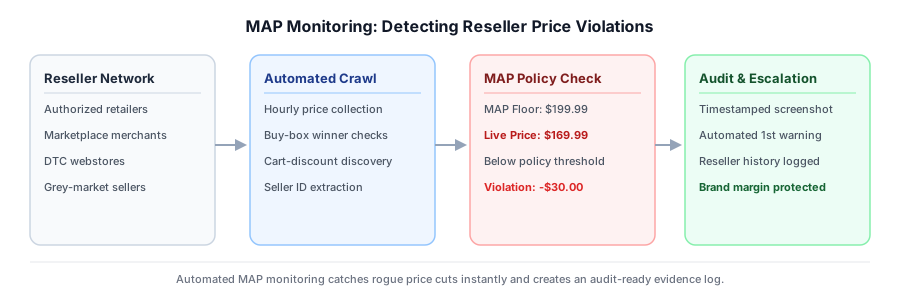
Minimum Advertised Price (MAP) is the lowest price a brand permits its resellers to *advertise* a product at. It governs public price display — product pages, marketplace listings, ads, banners, email — not the price a customer is ultimately charged at checkout. A reseller can sell below MAP; advertising below MAP is what the policy restricts.
That distinction is the whole point. Because MAP touches advertising rather than the transaction, brands can protect price perception across a reseller network without dictating the final sale price, which is a far riskier thing to do.
MAP, MSRP and RPM: three terms that get mixed up
- MSRP (manufacturer's suggested retail price) is a recommendation. Nothing is enforced, and resellers are free to price above or below it.
- MAP is a floor on advertised prices, usually issued as a unilateral policy with defined consequences — losing co-op marketing funds, losing authorised-reseller status, or losing supply.
- RPM (resale price maintenance) is an *agreement* between supplier and reseller that fixes the resale price. This is the legally dangerous category, and it is where MAP programmes drift when they are enforced through negotiation instead of policy.
If you remember one thing: MAP is a policy you announce, not a deal you strike. The moment a MAP conversation becomes a two-way agreement about final selling prices, it has stopped being MAP.
Is a MAP policy legal?
This is jurisdiction-dependent, and the answer differs enough between the US and Europe that a single global policy is usually a mistake. What follows is general background, not legal advice — take a MAP programme to counsel before you launch it.
- United States. Unilaterally announced pricing policies have long-standing footing: a supplier may state the terms on which it will do business and stop dealing with resellers who don't comply, provided it does not negotiate or extract agreement. Vertical price restraints are judged under a rule-of-reason standard rather than being automatically unlawful, but state law adds its own wrinkles.
- European Union. Resale price maintenance is treated as one of the most serious vertical restraints under EU competition law and does not benefit from the block exemption. National authorities have fined suppliers over pricing pressure applied to resellers, and MAP schemes are scrutinised closely when they operate in practice as a floor on selling prices.
- United Kingdom. The CMA has pursued RPM cases across several consumer-goods sectors, with the same emphasis: policing what resellers *charge* is where enforcement risk sits.
The practical takeaway for a data team: build the monitoring so it records what was advertised, where, and when — evidence of *display* — rather than becoming a mechanism for negotiating final prices with resellers.
What does MAP monitoring actually involve?
MAP monitoring is the continuous collection of every public price for your products across the reseller and marketplace landscape, matched back to your catalogue, compared against the MAP list, and turned into evidence a channel manager can act on.
Four things have to work:
- Coverage. Authorised resellers are the easy part. Violations concentrate in marketplace third-party listings, regional price-comparison sites, and grey-market sellers who never signed anything.
- Identity. Every collected offer has to be resolved to your SKU before it can be compared. This is a product matching problem, and it is the step that decides whether your violation report is trustworthy or noise.
- Frequency. A violation that appears for six hours during a flash sale and disappears is still a violation. Daily snapshots miss it; that is a choice you should make deliberately, per category.
- Evidence. A timestamped screenshot or archived page, plus the seller identity and the URL, is what makes a violation actionable. A number in a spreadsheet is not.
Where do MAP violations actually hide?
Teams that only compare the headline price on a product page catch maybe half of what is happening. The recurring hiding places:
- Marketplace buy-box and third-party offers, where the visible price changes by seller and by region.
- Cart-level discounts — the page shows MAP, the basket does not. Whether this breaches your policy depends on how your policy is worded, which is exactly why the wording matters.
- Coupon codes and automatic promotions applied at checkout or via a banner.
- Bundles, where a compliant unit price is buried in a package that implies a lower one.
- Paid search and shopping ads, where the advertised price sits in the ad creative rather than on the landing page.
- Product images and marketing copy with a burned-in price below MAP.
- Price-comparison feeds, which frequently carry a stale or lower price than the reseller's own site.
How do you build a MAP monitoring workflow?
The sequence that survives contact with a real reseller network:
- Publish the policy first. A monitoring programme with no clearly communicated MAP list, effective date, and consequence ladder produces reports nobody can act on.
- Define the violation. Advertised price only, or cart price too? Is a coupon a violation? Which channels are in scope? Write it down before you collect anything.
- Collect broadly, then match. Pull offers across reseller sites, marketplaces and comparison engines, then resolve them to canonical products. Coverage without matching just moves the problem downstream.
- Set thresholds and a grace period. Sub-1% deviations are usually feed rounding, not defiance. Most brands allow a short correction window before escalation.
- Escalate on a ladder. Automated notice, then account-manager contact, then commercial consequence. Consistency across resellers matters more than severity.
- Report on trend, not incidents. Violation rate by reseller and by category over time is what tells you whether the programme is working.
Which MAP metrics are worth reporting?
- Violation rate — violating offers as a share of all monitored offers, by reseller and by channel.
- Depth of violation — how far below MAP, in percent. A 2% breach and a 25% breach are different problems.
- Time to correction — hours from notice to compliant price. This is the number that shows whether escalation works.
- Repeat-offender concentration — the share of violations coming from your top five offenders. It is usually high, and it tells you where to spend effort.
- Unauthorised-seller count — offers from sellers with no relationship to you at all, which need a different remedy entirely.
Where MAP programmes go wrong
- Monitoring without a published policy. You end up with a violation list and no basis for acting on it.
- No product matching. Variant and bundle confusion generates false positives; after the third bad accusation, resellers stop taking notices seriously.
- Checking too rarely. Weekly crawls in fast-moving categories are close to decorative.
- Enforcing unevenly. Selectively pressuring some resellers while tolerating others is both commercially corrosive and the fastest way to turn a unilateral policy into something that looks like an agreement.
- Confusing MAP with competitive pricing. MAP protects your own advertised floor. Understanding what the market is doing is a separate discipline — see price intelligence.
Getting started
If you already have a MAP policy and need the data behind it, our MAP monitoring software tracks advertised prices across resellers and marketplaces with timestamped evidence, and our price monitoring platform covers the wider competitive picture on the same feed.
If your reseller landscape is broad and messy, start by scoping coverage rather than frequency: knowing about 95% of your sellers weekly beats knowing about 40% of them hourly.
For the neighbouring discipline — watching competitors rather than policing resellers — see our guide to competitor price monitoring. Definitions for the terms used here live in the pricing glossary.
Where this fits in the platform
Terms in this article

Strategic Lead, Senkrondata
Kerem leads strategy at Senkrondata, with years of experience in data engineering and market analysis.
Contact Us
Leave your email address for a detailed demo or overview session, and we will get back to you shortly.