
Category: Analytics
Dynamic Pricing for Black Friday: Into Cyber Week With Your Margin Intact
Black Friday prices change by the hour. Plan around the EU 30-day prior-price rule, a cost floor and scenario-based pricing to protect your margin.
Table of Contents13
This year Black Friday falls on Friday 27 November 2026, and Cyber Monday on 30 November. In practice the campaign rarely fits into a single day: Black Friday has stretched into Black Week and Cyber Week, and November discounting runs across the whole month. Throughout that time, competitor prices change several times a day, stock sells out within hours, and a single wrong price is repeated across thousands of orders.
This article shows how to prepare for Black Friday with dynamic pricing, how the EU's 30-day prior-price rule shapes your campaign calendar (including why Singles' Day now affects your Black Friday discount), and how to stay competitive without eroding your margin, step by step.
Why manual pricing falls short on Black Friday
The problem is not a lack of information, it is workload. Checking five competitors three times a day across a 5,000-product catalog means 75,000 comparisons. No team can do that in a spreadsheet. The result is usually one of three mistakes:
- Blanket discount: The whole category gets the same cut, say 20%. On products where the competitor is already more expensive, that discount is margin you never needed to give away.
- Late reaction: The competitor cuts its price at 9am, and you notice in the afternoon. By then the busiest hours of campaign day are gone.
- Wrong reaction: You cut your price to match a competitor that is out of stock or has entered a wrong price. An offer nobody can buy drags your price down.
Dynamic pricing prevents all three at once: the rule evaluates each product separately, the calculation takes seconds, and an out-of-stock competitor is left out of the comparison.
The rule: the "was" price is the lowest price of the last 30 days
Since 28 May 2022, every announcement of a price reduction in the EU has had to show the prior price: the lowest price the trader applied in the 30 days before the reduction. The rule comes from Article 6a of the Price Indication Directive (98/6/EC), added by the Omnibus Directive (EU) 2019/2161; Germany implements it in § 11 of its Price Indication Ordinance (PAngV). In September 2024 the EU Court of Justice went a step further in the Aldi Süd case (C-330/23): a percentage discount, or a claim that stresses how good the price is, has to be calculated from that 30-day low, not from the price charged the day before.
Member states may make exceptions for perishable goods, and for reductions that deepen step by step without interruption, where the reference can stay the price from before the first step. Germany allows both. Outside the EU there is usually no fixed window, but the principle is the same: in the UK, under the Digital Markets, Competition and Consumers Act 2024, a "was" price must be a genuine selling price for a reasonable period before the promotion, and in the US the FTC's Guides Against Deceptive Pricing expect the same of former-price comparisons. Turkey has used a 10-day window since 1 August 2026.
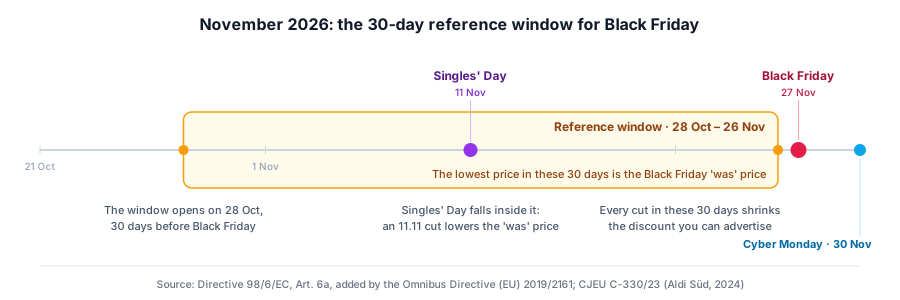
The rule has three concrete effects on your Black Friday calendar:
- The reference window runs from 28 October to 26 November. For a campaign that starts on 27 November, the "was" price is the lowest price of those 30 days. Every cut you make during that period in response to a competitor shrinks the discount you can show in the campaign.
- Singles' Day sits inside the window. An 11.11 discount on a product lowers that product's Black Friday reference price, even if the price went back up on 12 November. Either run Singles' Day on a different set of products from Black Friday, or plan for a smaller advertised discount on the products you use for both. The step-by-step exception does not help here: a discount that ends on 12 November and starts again on 27 November is not an uninterrupted reduction.
- Raising prices so you can show a bigger discount does not work. A raise inside the window leaves the 30-day low unchanged. A raise before the window that does not reflect a genuine price is still a misleading reference price under unfair commercial practices law. The same rules catch discount rates that were never actually applied, offers falsely presented as available for a very limited time, and stock claims that are not true.
In short, your Black Friday price is really set in October. Campaign week is the result of that preparation.
This article is not legal advice. Review your campaign copy and the way you present discounts with your legal team.
A four-stage Black Friday pricing plan
1. Preparation: 1–27 October
- Refresh your cost data. If exchange rates and supplier prices have moved, so have your floor prices. A floor calculated with old costs can have you selling at a loss during the campaign.
- Calculate your floor prices. For each sales channel, factor in cost, commission and shipping to set the price you will not go below under any circumstances. We walk through the floor price formula with an example in a separate article.
- Fix products priced far below competitors, before 28 October. Bringing them to where they should be is a genuine pricing decision, not a hike to show a discount. Made in early October and kept in place, the corrected price is the one that applies across the whole reference window.
- Prepare your scenarios. On campaign day you should not be writing rules, only switching to the scenario you have ready.
2. The reference window: 28 October – 26 November
These 30 days determine the "was" price you will show in the campaign. So:
- Keep prices as steady as you can. If your dynamic strategy keeps running, raise the minimum change threshold and allow only the price moves you really need.
- Decide which products take part in Singles' Day. Keep your Black Friday headline products out of it, or accept a smaller Black Friday discount on them.
- Finish your stock plan. Knowing how much stock you will have of each product during the campaign tells you where you can afford to be more competitive.
3. Campaign: 27–30 November
Switch to the campaign scenario. An example rule set might look like this:
- Rule: 3% below the cheapest in-stock competitor.
- Floor: Cost + 10%, fixed for the whole campaign.
- Change band: At most 30%.
- Stock status: Out-of-stock competitors are left out of the comparison; products that sell out are removed from the calculation.
- Frequency: A strategy that normally runs once a day is recalculated more often on campaign days.
Set the level of competition by category. On products that bring in traffic and are compared often, going below the competitor makes sense. On slow sellers, matching the competitor is usually enough; spreading the discount to them means spending the campaign budget where there is no competition.
4. After the campaign: 1 December onwards
When the campaign ends, pulling prices back to their old level overnight sends a harsh signal to customers and competitors alike. Use a "win back margin" scenario to move prices gradually toward the competitor average; the maximum change band prevents sudden jumps. We cover the move into the December gift season in the Q4 pricing calendar.
Example: the same six products, two scenarios
Take six products from a beauty catalog. In the everyday period the strategy runs on a "match Competitor B" rule. On Black Friday it switches to "3% below the cheapest in-stock competitor". The guardrails are the same in both scenarios: minimum change 1%, maximum change 30%, floor price cost + 10%.
- BB cream ($9.99; competitor prices $14.79 and $15.69): Because the competitors are much more expensive, the price goes up even on Black Friday. The increase is capped at 30%, and the price lands at $12.99.
- Gel eyeliner ($7.49): A 2.7% cut is suggested in the everyday period, 12.0% on Black Friday. The cheapest competitor is at $6.79, and the target price is $6.59.
- Waterproof mascara ($9.79): Competitor A is out of stock, so it is left out of the comparison. The rule works off Competitor B, and the target price becomes $9.21.
- Eyeshadow palette ($13.49; cost $9.80): The $10.18 the rule suggests is below the floor price, so the price stops at the $10.78 floor.
The six products' average gross margin rises from 43.5% to 45.3% in the everyday scenario and falls to 40.2% in the Black Friday scenario. That drop is controlled: no product goes below its floor, and there is no discount on the product where the competitor is already more expensive. The same calculation runs for thousands of products in seconds, and switching between scenarios takes one click.
You can try this example yourself in the interactive simulator on the Dynamic Pricing page.
Black Friday pricing checklist
- Has your cost data been updated within the last month?
- Has a floor price been calculated for every sales channel?
- Were products priced far below competitors fixed before 28 October?
- Have you checked your Singles' Day products against your Black Friday list?
- Are price moves between 28 October and 26 November kept to a minimum?
- Has the campaign scenario been prepared and tested?
- Are out-of-stock competitors kept out of the comparison?
- Does every discount show the lowest price of the previous 30 days, with the percentage calculated from it?
- Has the calculation frequency been raised for campaign days?
- Is a "win back margin" scenario ready for after the campaign?
Frequently asked questions
How is the "was" price set for Black Friday?
In the EU, the prior price is the lowest price you applied in the 30 days before the reduction, and the advertised percentage has to be calculated from it. For a campaign starting on 27 November, that window runs from 28 October to 26 November.
Do you need to discount every product on Black Friday?
No. Discounting products where the competitor is already more expensive is margin lost for nothing. Dynamic pricing applies discounts only to products where competition genuinely calls for them. On some products, the right move is to raise the price, even on campaign day.
What happens if a competitor changes its price again during the campaign?
When the strategy is recalculated, your target prices update to the competitor's new price. The floor price and the change band are applied again in every calculation; however far the competitor cuts, your price does not go below the floor.
To set up your Black Friday scenario now and update campaign-day prices in seconds, see Senkrondata Dynamic Pricing or request a demo.
Where this fits in the platform

Co-Founder & CEO
Okan Bircan is the Co-Founder & CEO of Senkrondata, leading data-driven growth for enterprises across e-commerce and price intelligence.
Contact Us
Leave your email address for a detailed demo or overview session, and we will get back to you shortly.