
Category: Analytics
What Is Dynamic Pricing? A Complete Guide for E-Commerce (2026)

What is dynamic pricing and how does it work? Competitor-based rules, the floor price formula, campaign periods and the EU 30-day rule in one 2026 guide.
Table of Contents23
Dynamic pricing means resetting product prices regularly, based on data such as competitor prices, cost, stock and the campaign calendar, instead of holding them to a fixed list. A price is not set once and left alone for months. Rules you write in advance re-evaluate every product, every day, with the same discipline: Should I be below the competitor on this product, level with it, or am I already selling it cheaper than I need to?
This guide explains what dynamic pricing is, how it works, which types actually pay off in e-commerce, and how to apply it without starting a price war. We also cover the discount rule you need to plan around as you head into the Q4 campaign season.
What is dynamic pricing?
In dynamic pricing, the price is the result of decisions you make. You decide which competitor to track, where you want to sit relative to that competitor, that you will never go below your cost, and how far the price may move in one step. The system applies those decisions to thousands of products at once.
Every dynamic pricing setup has three components:
- Input: Competitor prices, your own cost, stock status and the current period.
- Rule: Where the price should go given that input. For example, "Stay 5% below Competitor A."
- Guardrail: Limits the rule may never cross. For example, a cost floor and a change band.
Airline tickets and hotel rooms are the best-known examples of dynamic pricing. In e-commerce, its most common and most measurable form is competitor-based pricing. The reason is simple: the customer can compare the same product a few tabs away.
Static vs dynamic pricing
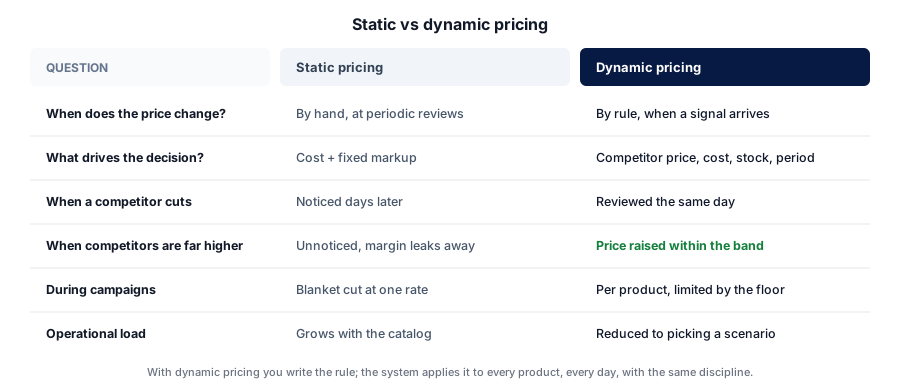
In static pricing, the price is usually set once with a "cost + fixed markup" formula and stays put until the next review. That is enough while the catalog is small. Once you have more than a few hundred products and more than five competitors, two problems appear:
- Late discounts: When a competitor cuts its price, you notice days later. In the meantime, the sale goes to the competitor.
- Invisible margin loss: Products you sell far below the competition never trigger a warning in any report. The customer is happy and you assume all is well, but you are leaving revenue on the table.
Dynamic pricing solves both problems with the same mechanism: every product is repositioned against competitors in every calculation.
How does dynamic pricing work?
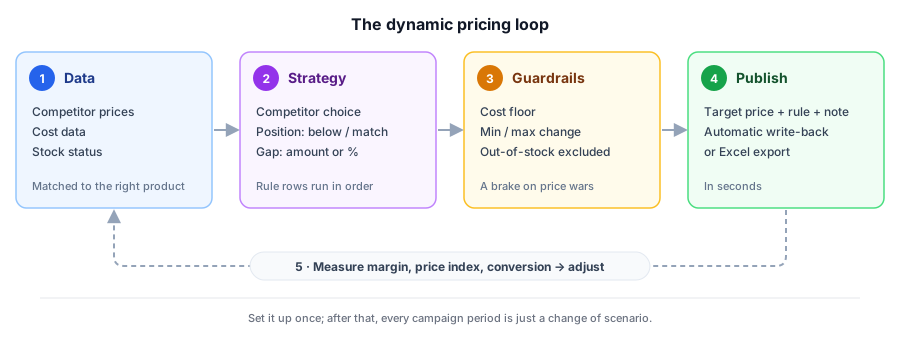
In practice the process is a five-step loop:
- Data is collected. Competitor prices and stock status are monitored, and your own costs are brought in through a cost file (feed). The competitor price must genuinely belong to the same product. That is what product matching ensures.
- The strategy is built. Which product group is priced against which competitor, and how, is written down as rule rows.
- Guardrails are applied. The price the rule suggests passes through the cost floor and the minimum/maximum change band.
- The price goes live. Approved target prices are written back to the store or marketplace automatically, or downloaded as an Excel file.
- The result is measured. Margin, price index against competitors and conversion rate are tracked, and the strategy is updated accordingly.
The most valuable part of this loop is speed. Once the rules are in place, target prices for thousands of products are recalculated in seconds. Changing strategy stops being a project and becomes a simple choice.
Types of dynamic pricing
Dynamic pricing in the true sense ties the price to a changing piece of data. In e-commerce, four types stand out.
Competitor-based pricing
You position your price against competitors you choose: below them, level with them or above them. It is the most widely used type in e-commerce. In categories where customers compare prices, such as electronics, beauty, baby products and DIY, it shows up directly in sales.
Time- and campaign-based pricing
You tie the price to the calendar: Black Friday, Singles' Day, Christmas, the end of a season. A different rule runs for the same product in each period. We cover how to act during campaign periods in detail in dynamic pricing for Black Friday and the Q4 pricing calendar.
Stock-based pricing
As stock runs low you reduce the discount; on overstocked products you set a more competitive price. A competitor's stock status matters too: a competitor that has run out should be left out of the price comparison. We explain why in out of stock is a signal too.
Demand-based pricing
The price goes up when sales accelerate and down when they slow. It is a powerful method, but it needs reliable demand data and enough sales volume. In most catalogs it serves as a secondary input alongside competitor and stock data.
Concepts that often get mixed up
Price skimming, penetration pricing and value-based pricing are general pricing strategies. They set the starting level of a price, but they do not tie it to changing data. Personalized pricing, which means showing the same product to different customers at different prices, is a separate topic: it bears directly on customer trust and on data protection law. In every method described in this article, the price of a product is the same for everyone; it changes only with time and market conditions.
How are competitor-based rules written in practice?
A competitor-based rule has three parts: competitor, position and gap.
- Competitor: Which store or marketplace seller is the reference?
- Position: Will your price be below the competitor's, the same, or above it?
- Gap: How big is the difference? It can be set as an amount ($1) or as a percentage (5%).
Rules run in order. For a beauty category, for example, you might write these two rows:
- Stay 5% below Competitor A.
- If Competitor A doesn't carry the product or it is out of stock, match Competitor B.
In one calculation on a 338-product category, this two-row strategy suggested price increases on 71 products and discounts on 77, and no change on the other 190. One of the increases looked like this: a BB cream was selling at $9.99 while the lowest competitor price was $14.79. The rule wanted to move it to 5% below Competitor A, which is $14.05, but the suggestion stopped at the strategy's cap, $11.99 (+20%). That is $2.00 of extra revenue per unit, on a single product, in a single calculation.
This example shows the least discussed side of dynamic pricing: a well-built strategy suggests price increases as often as discounts.
How do you calculate a floor price?
Every rule sits on top of a floor price. Whatever the competitor does, the price should not go below it. To find the floor, you work backwards from the selling price. Let's do the calculation net of VAT, using a marketplace product as the example:
- Product cost: $17.50
- Marketplace commission: 15% of the net selling price
- Shipping: $3.50
- Target minimum margin: 10% of the net selling price
Call the net selling price N. For the profit to cover the minimum margin, the following must hold: N − 0.15N − 3.50 − 17.50 ≥ 0.10N. That gives 0.75N ≥ 21.00, so N ≥ $28.00. Where the shelf price includes VAT, add it on top: at 20% VAT the floor on the shelf is $33.60.
If you sell this product on this marketplace below $33.60, you fall below your target margin. When a competitor cuts to $32.00, the right response is not to follow it, but to hold the floor and close the gap in other ways: shipping, a bundle offer or visibility.
Commission rates vary by category and marketplace, so the calculation has to be done separately for each sales channel. If your costs change often because of exchange rates or inflation, the floor price has to be updated just as often. That is why cost data should flow into the system on a regular basis instead of being copied over by hand.
The change band: skip small wobbles, cap big jumps
The floor price protects you on the way down. The change band works in both directions:
- Minimum change (for example 1%): changes below this rate are not applied. Raising a $5.49 lipstick to $5.52 looks like instability to the customer and adds almost nothing to margin.
- Maximum change (for example 20% or 30%): the price does not move more than this in one calculation. That way a price a competitor entered by mistake ($1.29 instead of $12.99) cannot drag yours to the bottom overnight.
A suggestion that falls outside the band is pulled back into it, and the product's note says so plainly ("Capped at max change"). That keeps it clear why each product sits at the price it does.
Dynamic pricing during campaign periods
Campaign periods are when dynamic pricing helps most, and when the most mistakes are made. Competitors change prices several times a day. Teams pricing by hand either react too late or apply the same discount to the whole catalog and give away margin they didn't need to.
In the EU, one rule shapes the whole campaign calendar: since 28 May 2022, the "prior price" shown in a discount announcement is the lowest price you applied in the 30 days before the reduction. If Black Friday starts on 27 November, every cut you make between 28 October and 26 November shrinks the discount you can show in the campaign, and that window includes Singles' Day. Build your campaign calendar around those 30 days. You will find the details in our Black Friday guide.
It also matters to recognise real discounts in competitors' campaigns. Does a competitor's "40% off" label show a genuinely new price, or has the old price simply been relabelled? We cover that in detecting fake discounts.
Case study: How MediaMarkt Türkiye lifted ROAS by 87%
MediaMarkt Türkiye's e-commerce team integrated Senkrondata's assortment monitoring solution into its Google Merchant Center workflows. Competitor products are collected daily, matched at scale, and product feeds are enriched with current market data before they reach a campaign.
The program runs across more than 10,000 products and 8 competitors, with a 97.2% data accuracy commitment and 12 runtime cycles a day. Campaign efficiency improved, and MediaMarkt achieved an 87% increase in ROAS.
"The most comprehensive competitive data we have ever worked with: actionable, real-time and reliable." — MediaMarkt Türkiye eCommerce Team
In this project, the result came from advertising efficiency, not from a pricing rule. But the input was the same one every dynamic pricing strategy depends on: competitor prices that are collected continuously, matched to the right product and clean enough to act on. Whether that data feeds a shopping campaign or a price change, its quality sets the limit of what automation can achieve.
Risks and how to manage them
- Price war: If two sellers keep undercutting each other by a cent, the price melts down to the floor. The fix is a cost floor and a change band in every rule.
- Wrong match: Pricing against a product in a different size only makes the wrong decision faster. The fix is to measure matching quality and keep doubtful matches out of the rules.
- Bad data: A competitor price falling 70% overnight is usually a data error. The fix is the maximum change band, plus human approval for unusual moves. We cover the whole decision chain in from competitor data to pricing action.
- Customer perception: Prices that change many times a day erode trust. The fix is a minimum change threshold and a sensible update frequency.
- Regulation: Discount announcements must show the correct prior price, and claims about how long an offer lasts or how much stock is left must be true. Those obligations apply to dynamic pricing too. Review your campaign copy with your legal team.
Which metrics should you track?
- Gross margin: Before and after the strategy, by category.
- Price index: Your price as a ratio of the competitor average (100 = level).
- Increase and decrease split: How many products went up, and how many went down, in each calculation?
- Conversion rate and units sold: In the 7 and 14 days after a price change.
- Products pulled to the floor or the band: Products that keep hitting the floor point to a problem on the cost or supply side.
Where should you start with dynamic pricing?
- Get your costs into the system. Without cost data there is no floor price. Start with an Excel file, then move to a link or an automatic integration.
- Pick one category. The category where competitor comparison is clearest and sales are most price-sensitive is a good starting point.
- Write a two-row rule. Choose one main competitor and one fallback.
- Keep the band narrow. In the first weeks, keep the maximum change at 10–15%, then widen it as you see results.
- Prepare your campaign scenario in advance. When Black Friday arrives, the only thing you should have to do is pick the scenario you have ready.
Frequently asked questions
Is dynamic pricing legal?
Yes. You are free to change your prices in line with market conditions. What you do have to follow are the rules on advertising discounts: in the EU, a price reduction must be shown against the lowest price of the previous 30 days, and claims about an offer's duration or stock must be true. Since the Omnibus Directive, EU traders also have to tell customers when a price has been personalized on the basis of automated decision-making, and prices based on personal data fall under data protection law.
Does dynamic pricing just mean discounting?
No. Raising prices on products sold far below the competition is, in most catalogs, the fastest way to improve profitability. In the example above, the strategy suggested almost as many increases as discounts.
How often should prices change?
It depends on the category. For most catalogs a daily calculation is enough, and the frequency can be raised on campaign days. The minimum change threshold already filters out unnecessary small changes.
Can a small e-commerce business use dynamic pricing?
Yes. A few hundred products and two or three competitors are already the point where manual tracking starts to slip. What matters is not the number of rules but keeping cost data current and calculating the floor price correctly.
Do you need AI for dynamic pricing?
A rule-based approach is both sufficient and more transparent for most businesses: you can always see why a product is at the price it is. AI earns its place less in setting the price than in matching competitor products correctly and filtering out unusual price moves.
To set up your competitor-based rules and see target prices for thousands of products in seconds, see Senkrondata Dynamic Pricing or request a demo.
Where this fits in the platform
Terms in this article

Strategic Lead, Senkrondata
Kerem leads strategy at Senkrondata, with years of experience in data engineering and market analysis.
Contact Us
Leave your email address for a detailed demo or overview session, and we will get back to you shortly.