
Category: Analytics
Q4 Pricing Calendar: Dynamic Pricing Through Every Campaign Period From October to January
From October prep to Singles' Day, Black Friday, Christmas and the January sales: which pricing scenario should run in each period of Q4 2026?
Table of Contents9
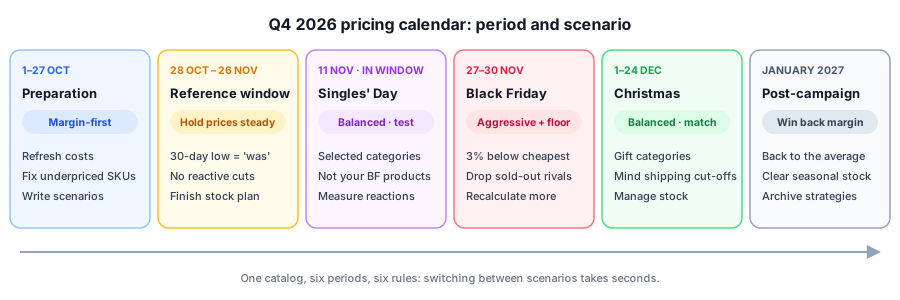
In e-commerce, the last quarter of the year is not one campaign but six periods in a row: the quiet weeks of October, the 30-day reference window before Black Friday, Singles' Day inside that window, Black Friday and Cyber Monday, the Christmas gift season, and the post-campaign weeks of January. In each one, competitors behave differently, customers look for different things, and the right pricing rule changes.
This article walks through Q4 2026 period by period. For each one, we cover which scenario should be running and why switching between periods should take seconds.
October: the preparation month
October is the least discussed and most profitable month of the quarter. It is the only period in which you can fix your price structure before campaign pressure begins.
- Refresh your cost data. If exchange rates and supplier prices have moved, so have your floor prices. If cost data is out of date, a discount that looks right in the campaign may in fact be a sale at a loss.
- Fix products priced below competitors, before 28 October. Products you sell far below the competition lose margin all quarter. Bringing them closer to the competitor level in October is a genuine pricing decision, and because the corrected price then applies across the whole reference window, you enter the campaign with a solid prior price.
- Write your scenarios. Prepare at least four scenarios for the quarter: everyday, campaign, Christmas and post-campaign. You will find example rules for each period below.
- Test the scenarios on one category. Apply the scenario to your real catalog and look at how the suggested increases and decreases are spread. Products that keep hitting the floor or the band tell you the problem is in your cost data, not in the rule.
Scenario: Margin-first. Example rule: match the main competitor; on products far below the competitor, raise the price by at most 20%.
28 October – 26 November: the reference window
In the EU, the "prior price" shown in a discount announcement is the lowest price you applied in the 30 days before the reduction, and the advertised percentage has to be calculated from it. For a Black Friday campaign starting on 27 November, those 30 days run from 28 October to 26 November.
The job in this period is simple, but it takes discipline: keep prices as steady as you can. You don't need to stop your dynamic strategy, but you should raise the minimum change threshold and allow only the price moves you really need. We explain this period and the rule's three main effects in dynamic pricing for Black Friday.
Scenario: Steady. Example rule: raise the minimum change threshold from 1% to 5%.
11 November: Singles' Day
Singles' Day is the season's first big test, and for many sellers a dress rehearsal for Black Friday. Instead of discounting the whole catalog, work with selected categories and measure which products competitors react on and how your margin is affected.
Under the 30-day rule, one calendar point matters more than any other: 11 November sits inside the Black Friday reference window. A Singles' Day discount lowers the Black Friday "was" price of every product it touches, even if the price goes back up the next day. So keep Singles' Day and Black Friday on different products, or accept a smaller advertised Black Friday discount on the products they share.
Scenario: Balanced. Example rule: in selected categories, match the cheapest in-stock competitor.
27–30 November: Black Friday and Cyber Monday
In campaign week, speed matters most. Competitors change prices in the morning, at midday and in the evening, and stock sells out during the day. In this period:
- Switch to the campaign scenario and raise the calculation frequency.
- Fix the floor price. However far a competitor cuts, your price should not go below cost plus your minimum margin.
- Keep sold-out competitors out of the comparison. An offer nobody can buy should not drag your price down.
- Set the level of competition by category. Go below the competitor on products that bring in traffic; on slow sellers, matching the competitor is usually enough.
Cyber Monday (30 November) campaigns usually put electronics and accessories front and centre. Defining a separate scenario for those categories, instead of spreading the campaign across the whole catalog, protects your margin.
Scenario: Aggressive. Example rule: 3% below the cheapest in-stock competitor; floor price cost + 10%; maximum change 30%.
1–24 December: the Christmas gift season
In December, customers are more sensitive to time than to price: they want the gift in hand before Christmas. So:
- In gift categories such as perfume, beauty sets, small electronics and toys, matching the competitor is usually enough; you don't need to be as aggressive as on Black Friday.
- As shipping cut-off dates approach, manage stock rather than discounts. Orders placed after your carrier's last shipping date before Christmas may not arrive in time. A discount in that period can drive up returns rather than sales.
- On products you can deliver quickly, price pressure eases. You can add a separate rule row to protect margin on those products.
Scenario: Balanced. Example rule: in gift categories, match the cheapest in-stock competitor.
Late December and January: post-campaign and clearance
The weeks after Christmas bring two opposite needs at once: returning from campaign prices to normal prices, and clearing seasonal stock in the after-Christmas and January sales.
- Win back your margin gradually. Pulling prices back to their old level overnight sends a harsh signal to customers and competitors alike. Move back toward the competitor average step by step; the maximum change band limits the size of each step in every calculation.
- Run a separate rule for overstocked products. For winter items, Christmas sets and products at the end of their season, staying below the competitor is more profitable than leaving them in the warehouse. A product group split by stock status makes this easier.
- Remember that a January sale has a window of its own. Its "was" price is the lowest price of the 30 days before it, which by then means your December price, not your pre-Black Friday price.
- Archive your Q4 strategies. Don't delete your campaign strategies; they will be your starting point for the same period next year.
Scenario: Win back margin. Example rule: return to the average price of in-stock competitors; maximum change 15%.
Why should switching between periods take seconds?
In the last quarter, the strategy changes at least six times in three months. On a 5,000-product catalog, making each switch in a spreadsheet means hours of work every time. On top of that, the most critical switches often happen at midnight: many Black Friday campaigns start in the first minute of 27 November.
With scenario-based dynamic pricing, a switch is a simple choice. The rules are written in advance. When the period comes, you change the scenario, target prices are recalculated in seconds, and they are either written back automatically or downloaded as an Excel file. That way the team spends its time reviewing results rather than writing rules.
We explain how rules are built, how the floor price is calculated and the types of dynamic pricing in our guide to what dynamic pricing is.
Metrics to track through the quarter
- October: Price index against competitors and the number of products priced below competitors.
- Reference window: The number of price changes made in these 30 days (target: close to zero).
- Singles' Day: Change in margin and conversion rate in the test categories, and how many Singles' Day products are also on your Black Friday list.
- Campaign week: Number of products pulled to the floor, how fast stock sells out, and hourly sales.
- December: Conversion rate in gift categories and the share of orders placed after the last shipping date.
- January: How fast margin returns to its pre-campaign level, and remaining stock on seasonal products.
A short Q4 checklist
- Cost data refreshed in the first week of October.
- Products priced below competitors fixed before 28 October.
- Four scenarios (everyday, campaign, Christmas, post-campaign) written and tested.
- Singles' Day products kept apart from your Black Friday headline products.
- Price moves limited between 28 October and 26 November.
- Calculation frequency raised for campaign week.
- Carriers' last shipping dates added to the December scenario.
- Overstocked products moved into a separate group for January.
To prepare your Q4 scenarios on a single catalog and update your prices in seconds in every period, see Senkrondata Dynamic Pricing or request a demo.
Where this fits in the platform

Co-Founder & CEO
Okan Bircan is the Co-Founder & CEO of Senkrondata, leading data-driven growth for enterprises across e-commerce and price intelligence.
Contact Us
Leave your email address for a detailed demo or overview session, and we will get back to you shortly.