
Category: Analytics
Discount or New Normal? Telling Fake Promotions from Real Price Moves
How does promotion detection work? How Senkrondata separates list price from special price to tell a genuine discount from a decorative anchor.
Table of Contents5
A competitor slapped a "40% off" tag on a product. Should you panic and cut prices too? The answer depends on whether that "discount" is really a promotion or has quietly become the new normal price — and confusing the two is one of the most expensive pricing mistakes there is.
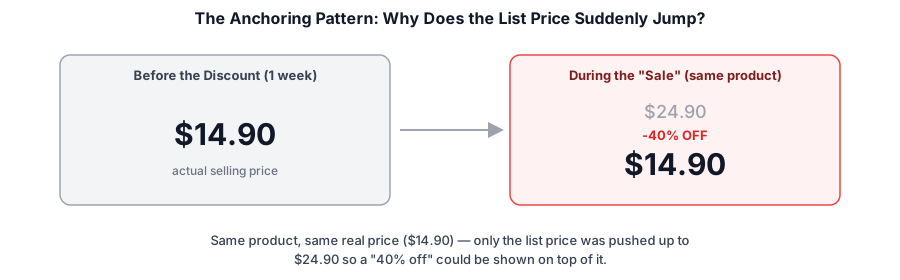
The problem: a screen showing "119 instead of 199" doesn't mean the product ever actually sold at 199. That "struck-through" price is often a purely decorative anchor no one has paid in months.
Two prices, one tag
The foundation of correct promotion analysis is recording two numbers separately for every price observation:
- List / regular price: the number shown as the product's "real" price.
- Special / discounted price: what the customer actually pays (when there's no discount, the two are equal).
Flattening these into a single "price" field makes promotions invisible. Kept apart, you can measure the gap between the "actual selling price" and the "claimed discount." Add a promotion flag kept on each observation (was this price part of a campaign?) and the picture sharpens.
The patterns that give away a fake promotion
Reading price history (see the price history model) along the time axis, "real discount" and "decorative discount" leave different signatures:
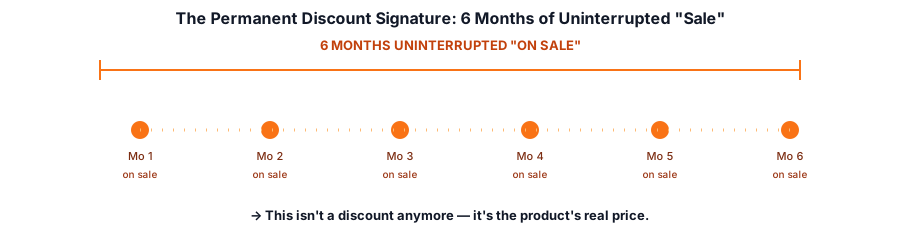
- A permanent discount = the real price. If a product has been continuously "on sale" for six months, that special price is the product's real price; the list price is just decoration. Compare against it and you'll think the competitor is pricier than they are.
- The list price "jump." Pushing the list price up right before a discount starts, then "cutting" it — a classic anchoring trick to make the discount look deeper. History exposes this.
- Discount rhythm. Some products go on sale on a predictable schedule (every month-end, every weekend). That isn't an "opportunity," it's the competitor's price architecture.
What the right signal changes
Being able to separate promotion from real price movement translates directly into better decisions:
- You avoid overreacting. You don't stare at a competitor's decorative "40%" tag and burn margin on an unnecessary real discount.
- You catch the real drop in time. If a competitor quietly (without calling it a campaign) lowered its price permanently, you see it as a strategic move, not "discount noise."
- You benchmark your own campaign. Is your discount actually deeper than the competitor's, or are you anchoring too?
The principles that keep it trustworthy
- Never confuse list price with paid price. Comparison must always be on the price the customer actually pays.
- A promotion is judged with its history. A single observation says "there's a discount"; only the time series says whether that discount is real.
- Permanence cancels the promotion. A discount that never ends isn't a discount.
The bottom line
"40% off" is a marketing sentence, not a fact. When you separate list price from special price and read it alongside price history, you can see which discount is a genuine opportunity and which is just a decorative anchor — and you respond to the competitor's real price, not their marketing language.
If you want to tell whether competitor discounts are real, talk to the Senkrondata team.
Where this fits in the platform
Price Intelligence & Data Engineering
Emre writes about the machinery behind competitor price data: product matching, normalization, collection at scale and the analytics layer on top.
Contact Us
Leave your email address for a detailed demo or overview session, and we will get back to you shortly.