
Category: Analytics
Store by Store: Why Price Monitoring Needs a Location Dimension
What is location-based price monitoring? The same product can cost different amounts at two branches — how Senkrondata collects branch-level data.
Table of Contents5
A product can cost 45 at one branch of a grocery chain and 49 at another branch of the same chain across town. Same brand, same product, same day — different price. That's not a bug, it's a deliberate strategy: rent cost, local competition, delivery distance push retailers toward regional pricing. The problem is, if you try to answer "what's the competitor's price?" with a single national number, you miss this reality entirely.
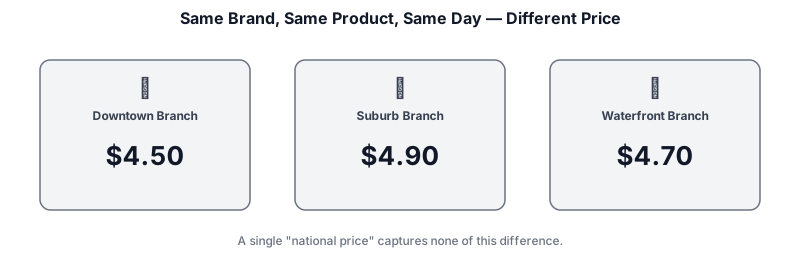
Where the "single price" assumption breaks
Traditional price tracking assumes a product has one price on one channel. That assumption mostly holds for e-commerce but breaks quickly in two areas:
- Physical retail chains: regional price differences between branches of the same brand are normal.
- Delivery / quick-commerce platforms: a product's price depends on the nearest branch/warehouse serving the ordering neighborhood — the same app, the same product, can show a different price when you change your location.
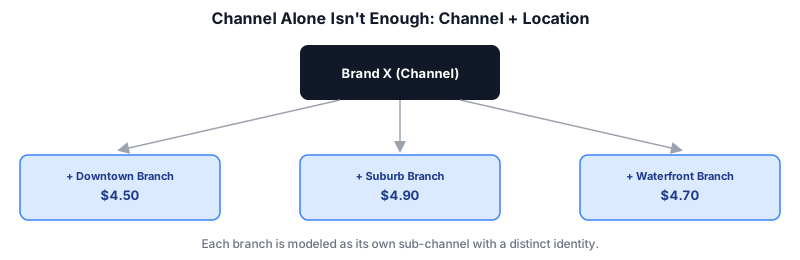
In both cases, "channel" alone isn't a sufficient unit; the real unit is the channel + location combination.
Modeling location as a dimension
The way to collect this correctly is to treat every point of sale (branch, neighborhood, delivery zone) as a separate sub-channel with its own identity. In practice, this means the crawler doesn't query a single brand page — it queries each location separately. On delivery platforms this usually means simulating "the nearest branch that delivers to this address" and pulling that branch's catalog and prices.
As a result, in the data model every product record carries not just which brand it belongs to but which branch/region. Without that distinction, different branch prices for the same product overwrite each other and the data becomes meaningless.
What location data unlocks
- A map of regional pricing strategy: where is the competitor more aggressive, where more expensive? Is this a rent/cost map, or a competitive-density map?
- A fair comparison against your own branches: when you say "the competitor," which of their branches do you mean? Your İzmir branch should be compared to their İzmir branch — not a national average.
- Neighborhood-level competition on delivery platforms: if the same brand serves two neighboring areas from different warehouses/branches, prices can differ — seeing that also surfaces local promotion opportunities.
The principles that keep it trustworthy
- Location is a primary dimension, not a detail. Separating price from location makes regional strategy invisible.
- Compare at the same level. Comparing a national price to a local one, or a branch to a branch in the wrong region, is misleading.
- Each location has its own freshness cycle. Stale data at one branch doesn't guarantee freshness at others — freshness is checked per location.
The bottom line
"What's the competitor's price?" is an incomplete question in physical retail and delivery platforms — the right question is "what's the competitor's price in this region?" Modeling location as a channel dimension makes regional pricing strategy visible and makes comparisons genuinely fair.
If you want to see regional/branch-level price competition, talk to the Senkrondata team.
Where this fits in the platform
Price Intelligence & Data Engineering
Emre writes about the machinery behind competitor price data: product matching, normalization, collection at scale and the analytics layer on top.
Contact Us
Leave your email address for a detailed demo or overview session, and we will get back to you shortly.