
Category: Analytics
Where Do You Rank on the Marketplace? Tracking the Visibility That Matters as Much as Price
Where do you rank on the marketplace? The right price is useless if no one sees it — how we track search ranking and buy-box visibility.
Table of Contents5
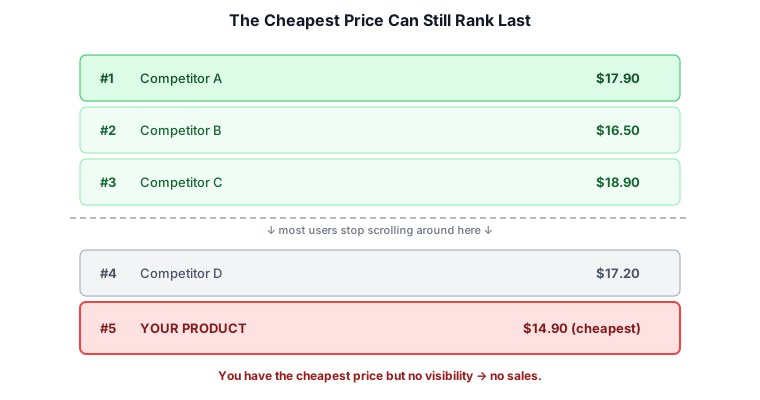
You can have the best price on a marketplace — but if your product is on the third page of search results, nobody sees that price. A brutal truth in e-commerce: an invisible product is an unsold product. Price is half the competition; the other half is what position that price shows up in.
So competitor tracking adds a second question next to "what is the competitor charging?": "is the competitor showing up before me?"
Why visibility is an axis independent of price
Two products can be at the same price yet show completely different sales performance — because one appears first in search and the other tenth. Marketplace ranking is a composite of many factors: price, stock, seller rating, review count, ads, and the platform's own algorithm. So ranking isn't a consequence of price — it's an independent metric that must be measured separately.
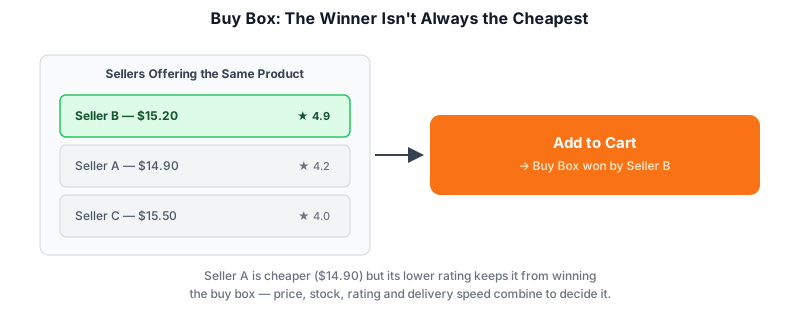
The same logic applies to the buy box: on marketplaces where multiple sellers offer the same product, the "Add to Cart" button defaults to a single seller. Whoever wins that box takes the lion's share of sales — and it isn't always the cheapest one who wins.
Tracking ranking: one query, one position
Ranking data requires a different collection logic than price data. To read a product's price, visiting the product page is enough; but to know its ranking you have to run a search query the way a buyer sees it and record the position of each product in the result.
Senkrondata processes this kind of data through a ranking-specific collection scenario: each product's position at the moment it was observed (what rank it held) is recorded alongside its price. That makes it possible, over time, to answer "in which search, at what position, at what price was this product showing?"
What visibility data unlocks
- My price is competitive but sales are flat — why? Maybe it's not price but visibility — your product isn't even on the first page.
- When the competitor cut price, how did its ranking move? You can measure the real relationship between price and visibility.
- When did I lose the buy box? And what did the competitor do at those moments (cut price, refresh stock)?
- Are they ahead via ads or organically? Is the competitor's top position bought or earned?
The principles that keep it trustworthy
- Ranking isn't independent of the query. The answer to "what's your rank?" is meaningless without "in which search?" — position is always measured in a query context.
- Position is also a time series. A single observation can mislead (personalization, ad rotation); the pattern only reads over time.
- Visibility and price are read together. Tracking them separately is incomplete; the value is in the "which visibility at which price" relationship.
The bottom line
The visible face of competitor tracking is price, but what drives sales is often visibility. Tracking search ranking and buy-box status alongside price answers "why can't I sell despite my competitive price?" — because sometimes the problem isn't your price, it's that no one is seeing it.
If you want to track your marketplace visibility alongside your price, talk to the Senkrondata team.
Where this fits in the platform
Price Intelligence & Data Engineering
Emre writes about the machinery behind competitor price data: product matching, normalization, collection at scale and the analytics layer on top.
Contact Us
Leave your email address for a detailed demo or overview session, and we will get back to you shortly.