
Category: Analytics
From Competitor Data to Pricing Action: How a Repricing Decision Is Built
How is a repricing decision built? Senkrondata’s signal-to-action chain — alert, recommendation, rule and human approval — step by step.
Table of Contents6
You've collected competitor price data. Now what? A table full of competitor prices produces no value on its own — value appears the moment that data becomes a decision. But automation as naive as "the competitor dropped, so we drop" quickly turns into a margin disaster or a price war.
The real difficulty of repricing isn't calculating a price, it's deciding when, by how much, and with what confidence to move. That's not a single formula, it's a layered decision chain.
The head of the chain: a trustworthy signal
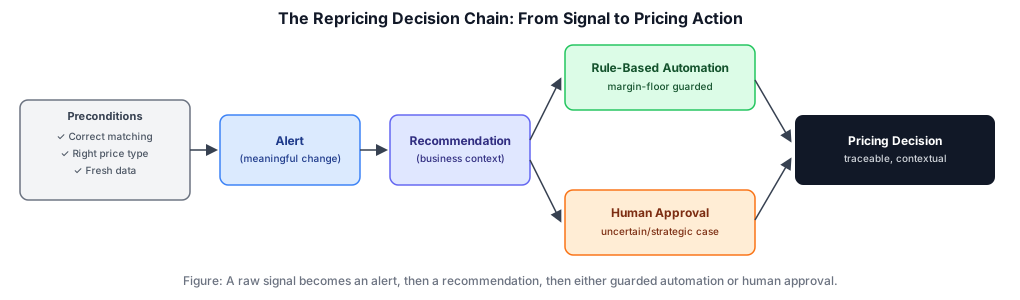
Every repricing decision is only as good as the data feeding it. So three preconditions sit at the head of the chain:
- Correct matching. Is the competitor price you're comparing actually the same product? (Wrong match = wrong decision; see product matching.)
- The right price type. Is the number being compared the real paid price, not a decorative list price? (See detecting promotions.)
- Fresh data. Is the decision based on today's price, or a three-day-old remnant?
Any "smart" repricing done before these preconditions hold is really just reacting to noise.
Step 1 — Detect the change (alert)
The first active step is noticing a meaningful change. Not every price flicker is an alert — the threshold matters. "Competitor down 0.5%" is usually noise; "competitor down 15% on a key product" is a signal. A good alerting system separates the important from the trivial and delivers it to the right person at the right moment (a Slack notification, say).
Step 2 — Add context (recommendation)
An alert says "something happened"; a recommendation says "here's what to do about it." The difference is context:
- Is this product strategic for you (traffic-driving, margin-carrying) or long tail?
- Is the competitor usually a price leader or a follower on this product?
- How much room does your current margin on this product leave for a response?
The recommendation layer enriches the raw signal with business context and offers concrete options like "match / ignore / differentiate."
Step 3 — Rule or human? (action)
Action comes at two speeds:
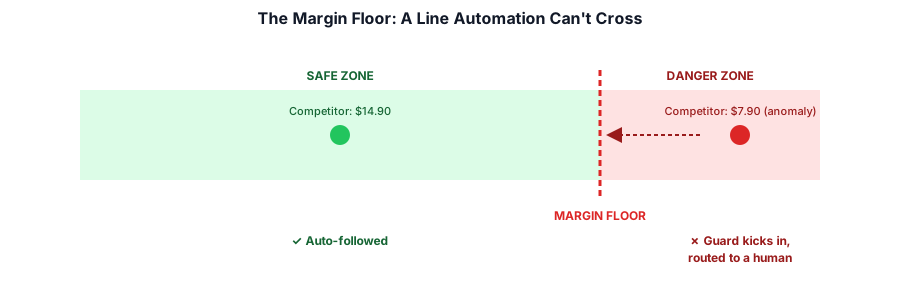
- Rule-based automation is ideal for predictable, low-risk cases: "in this category, as long as you stay above this margin floor, auto-follow the competitor." Automation is fast but must not be blind — every rule needs a margin floor and an upper/lower bound guard so a competitor's mistake can't drag your price off a cliff.
- Human approval steps in for high-impact, uncertain, or strategic decisions. Wherever automation is unsure, the decision moves to a human.
The principles that keep it trustworthy
- Every action has a guardrail. Automated repricing without a margin floor is an open invitation to a price war.
- Don't follow blindly. Watching a competitor isn't imitating one; sometimes the right move is to hold price and differentiate.
- Decisions leave a trail. Which signal, through which rule, led to which price is recorded — so "why did we drop to this price?" can be answered.
The bottom line
Repricing isn't "the competitor dropped, so we drop." It's a layered chain that starts with a trustworthy signal and moves from alert to recommendation, then to guarded automation or human approval. Run raw competitor data through that chain and your pricing decisions rest on context, not panic.
If you want to turn competitor data into guarded, context-aware pricing decisions, talk to the Senkrondata team.
Where this fits in the platform
Terms in this article
Price Intelligence & Data Engineering
Emre writes about the machinery behind competitor price data: product matching, normalization, collection at scale and the analytics layer on top.
Contact Us
Leave your email address for a detailed demo or overview session, and we will get back to you shortly.