
Category: Analytics
How to Improve Restaurant Ratings on Food Delivery Platforms
Why do food delivery ratings drop? Learn how analyzing branch performance, reviews, and competitor benchmarks drives higher scores.
Table of Contents35
When a restaurant's rating drops on a delivery platform, the first reaction is almost always the same:
"We need to get more positive reviews."
Yet in multi-branch restaurant chains the real problem is rarely the number of reviews.
The problem is not knowing why the rating is falling.
At one branch delivery time may be the issue, while at another it is portion size, packaging, order accuracy or food quality. The same product can score highly at one location and generate complaint after complaint at another.
So the starting point for raising a restaurant's rating is not "How do we get more 5-star reviews?" but:
"At which branch, when, and for what reason are we losing rating points?"
That distinction matters. Academic work shows that online reviews play a meaningful role in consumer decisions. A comprehensive meta-analysis published in 2024 found that the online review attributes examined showed significant relationships with purchase intent, and that review valence — whether reviews are positive or negative — is one of the strongest factors.
Research specific to the restaurant sector likewise links online ratings to trust and purchase intent.
For that reason a restaurant rating is better treated not merely as a "customer satisfaction score" but as one of the key indicators of operational and competitive performance. With our restaurant analytics platform you can track the performance of your branches as it happens.
First, Understand How the Rating Is Calculated
To raise a rating you first need to know how it forms.
Yemeksepeti, one of Turkey's largest delivery platforms, is a useful worked example because it publishes its method. According to its current guidelines users rate orders they have received on a scale of 1 to 5.
For a restaurant's average to appear at all, it needs ratings from at least 5 different users.
More importantly, the restaurant average is calculated from a maximum of 150 distinct user ratings given in the last 3 months.
That detail matters a great deal to restaurant managers.
Because the rating is not an unchanging average of every review accumulated over the years.
Recent customer experience is what moves the number.
So instead of dwelling on low ratings collected in the past, a more useful question is:
Why have our customers given low ratings in the last three months?
And, for chains, the follow-up:
Which branches is this problem concentrated in?
Why Does a Restaurant Rating Fall?
There is never a single cause.
Reading the reviews reveals that identical rating drops sit on top of completely different operational problems.
Customers tend to report repeated negative experiences in these areas:
Delivery
- The order arriving late
- Food arriving cold
- The estimated delivery window being exceeded
Packaging
- Spilled items
- Leaking drinks
- Items mixed together
- Forgotten sauces or extras
Food Quality
- Over- or undercooked items
- Portions not meeting expectations
- Product standards varying between branches
- The item not matching its photo or description
Order Accuracy
- The wrong item sent
- Missing items
- The customer note ignored
- Forgotten extras
Price and Value Perception
- Portion-to-price balance perceived as poor
- High price relative to competitors
- A promotion not seen as good enough
Platform merchant agreements generally place clear obligations on the restaurant to prepare the order correctly and completely, package it appropriately, and resolve order-related errors — Yemeksepeti's merchant agreement is explicit on this point.
But the real task here is not reading negative reviews one by one: it is finding the recurring problem.
Why Looking at the Brand Average Is Not Enough
One of the most common problems we see in multi-branch chains is looking only at the brand average.
Suppose a 50-branch chain has an average rating of 4.3.
At first glance nothing looks seriously wrong.
But looking at the distribution:
- 35 branches at 4.4–4.7
- 10 branches at 4.1–4.3
- 5 branches at 3.6–3.9
The brand average hides the problem.
And the customer never sees the brand's national average. They see the branch in the area they are ordering from, and its alternatives.
For chains, these indicators therefore need tracking separately:
- Which branches have the lowest ratings?
- Which branches lost the most rating points in the last 7 or 30 days?
- In which locations are we behind our competitors?
- In which branches is the share of negative reviews rising fast?
The answers to these offer far more actionable information than the brand average.
Watch the Rating Trend, Not Just the Rating
Suppose two of your branches both sit at 4.2 today.
The first branch's history: 3.9 → 4.0 → 4.1 → 4.2
The second branch's history: 4.6 → 4.5 → 4.4 → 4.2
Today the two restaurants look identical.
Operationally they are in completely different situations. The first branch is improving. The second is still losing performance.
So rather than tracking only the current rating:
- Daily or weekly change
- 7-day trend
- 30-day trend
- Number of new ratings
- Change in negative reviews
should be examined together.
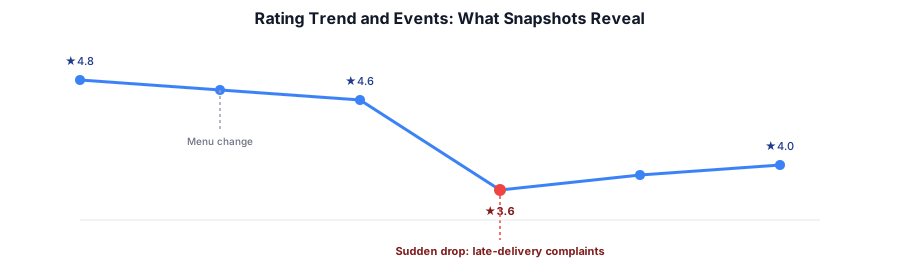
The goal is not to discover the branch that has already fallen to 3.8, but to notice as early as possible the branch that has started sliding from 4.5 to 4.4.
Categorize Negative Reviews Instead of Reading Them One by One
In a 10-branch restaurant group, reviewing feedback manually may be feasible. At 50, 100 or more locations the process quickly becomes unmanageable.
Customers describe the same problem in different ways:
- "It arrived very late."
- "The food was stone cold by the time it came."
- "Delivery took far too long."
- "It said 45 minutes but arrived much later."
The sentences differ; the operational problem is the same: delivery.
Likewise:
- "The portion has shrunk."
- "Far too little for this money."
- "It used to be bigger."
share a common theme: portion and value perception.
When you group hundreds of reviews into categories like:
- Delivery
- Packaging
- Portion
- Food quality
- Order accuracy
- Price
- Promotions
- Staff and service
customer reviews become far more meaningful.
We cover how to build that classification, who should run the response operation behind it, and how to separate a one-off incident from a systemic problem, in managing negative reviews on delivery apps.
If, for instance, 32% of the last 30 days' negative reviews concern delivery, 21% packaging and 17% portion size, it becomes much clearer where the operations team should start.
Research on online reviews likewise shows that it is not only the rating that matters for consumer behaviour, but the content and valence of the reviews.
The Problem May Be One Product, Not the Whole Restaurant
When a rating falls, the entire operation sometimes comes under question. Yet the problem may come from just a few products.
If a newly launched menu item constantly draws:
- "small portion",
- "arrived cold",
- "badly packaged",
- "not like the photo"
then working on that product makes more sense than overhauling the whole restaurant.
What is even more valuable in chains is comparing the same product across branches.
If the same burger:
- receives positive reviews at the Kadıköy branch,
- ordinary ones at Beşiktaş,
- and constant "arrived cold" complaints at Bakırköy
then the issue is more likely in preparation or delivery than in the recipe.
At that point the problem stops being "Customers don't like our burger" and becomes: "Why does the same product cause trouble only in certain locations?" That distinction is far more valuable to central operations teams.
How Does the Platform Ranking Algorithm Work?
There is a great deal of guesswork online. It is more reliable to look at what the platforms themselves publish — Yemeksepeti's merchant agreement, for example.
According to that agreement, the structure used to list and rank restaurants can vary by filter and by search.
The agreement states that restaurant ranking draws on parameters such as:
- Opening hours
- Distance to the user
- Delivery time
- Size of the discount applied
- Number of orders received
- Reviews and ratings
- Number of clicks
For product search results, it notes that restaurant rating and product relevance can be taken into account.
There is an important distinction here: the platform does not disclose the weight of these factors.
So a definite claim like "raise your rating by 0.2 and you will climb three places" is not sound. But on the basis of the official document we can say ratings and reviews are among the signals used in ranking.
Tracking rating performance therefore matters not only for brand reputation but for visibility on the platform.
Is 4.3 Good or Bad? It Depends on Your Competitor
A restaurant scoring 4.3 may look good at first glance.
But if competitors in the same area sit in the 3.8 – 4.1 range, 4.3 may be strong performance. If they sit at 4.5 – 4.7, the same 4.3 means something entirely different.
In restaurant performance, therefore, relative performance matters as much as the absolute rating.
For example:
| Restaurant | Rating |
|---|---|
| Your branch | 4.2 |
| Competitor A | 4.6 |
| Competitor B | 4.5 |
| Competitor C | 4.1 |
Here it is not enough to say "4.2 is not a bad rating." If the customer can reach two better-rated alternatives on the same screen, the competitive conditions are different.
Competitor benchmarking should not look at the rating alone. Indicators worth examining together:
- Restaurant rating
- Number of reviews
- Menu prices
- Promotions
- Product range
- Rating change
- Price changes
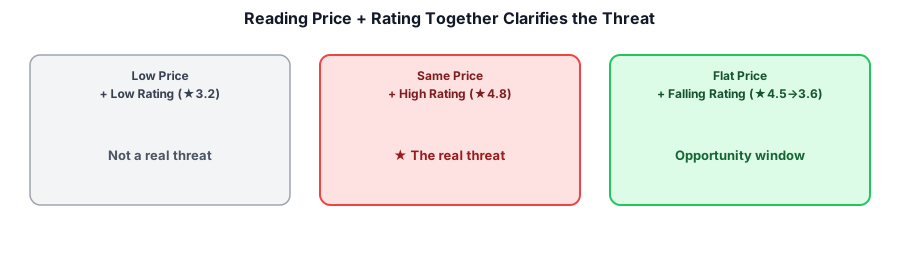
The question then stops being "What is our rating?" and becomes "How are we performing against competitors in the area we operate in?"
Can a Rating Really Affect Restaurant Revenue?
One frequently cited study here is Michael Luca's research at Harvard Business School using Yelp restaurant data.
The study found that a one-star increase in a Yelp rating was associated with roughly a 5–9% increase in revenue for independent restaurants.
But there is an important detail: the same effect was not observed for chain restaurants.
So it would not be correct to say "raising a delivery platform rating by one star increases revenue by 9%." The study was conducted in a different country, on a different platform, under different conditions.
Even so, it remains one of the important examples of why online restaurant reputation should be assessed alongside consumer decisions and commercial performance. Other restaurant-sector research has reported findings suggesting that review volume and rating may be related to restaurant profitability.
Your Best Branches Can Tell You What to Do
Chains have a significant advantage over their competitors: you do not always need a competitor to benchmark against.
Within your own organisation you have dozens of different operational examples.
In an 80-branch chain, for instance:
- Alsancak: 4.7
- Kadıköy: 4.6
- Çankaya: 4.6
If some branches hold those ratings while others sit at 4.0, looking only at the underperforming branches is not enough. You also need to investigate why the high performers are good.
For example:
- Are preparation times shorter?
- Is the packaging method different?
- Do certain products draw fewer complaints?
- Is there a difference in shift or kitchen operations?
- Do customers rate the same product more highly?
The aim is not to find and punish the underperforming branch; it is to find the operating model that works and carry it to the others.
Multi-branch rating analysis can therefore double as an internal benchmarking system.
How Do You Fix a Low Rating?
To fix a low rating you first need to find the source of the problem. In practice the process can run like this:
- The rating dropped
- Which branch did it drop at?
- What date did the decline start?
- Did negative reviews increase in the same period?
- Which topic recurs in the reviews?
- Is there a concentration in specific products?
- What changed at competitors in the same period?
- Take operational action
- Measure the result again in the following weeks
Applied consistently, this model lifts rating management out of the "team that replies to reviews" bracket and turns it into genuine performance management.
Can Negative Reviews Be Deleted?
Whether reviews can be removed is one of the things restaurant managers naturally look into.
According to Yemeksepeti, reviews are assessed not on whether they are positive or negative but on whether they comply with publication criteria.
Content that breaches those criteria — insults, threats, hate speech, personal data violations, advertising or redirection to other sites — can be rejected or removed.
But a review being unfavourable for the restaurant is not on its own enough for it to be taken down.
The durable solution is therefore not trying to remove the negative review but preventing the same complaint from arising again.
If 15 different customers complained about packaging in the last two weeks, the value is not in handling 15 reviews individually but in finding the shared operational problem.
Don't Wait for the Drop: Build an Early Warning System
When a branch falls to 3.7, the problem is easy to spot.
The real value is catching the change when it starts sliding from 4.5 → 4.4.
In multi-branch chains especially, specific alert rules can be defined.
For example:
- Branches whose rating fell noticeably in the last 7 days
- Restaurants dropping below a defined rating level
- Branches whose negative review count is climbing fast
- Locations falling below the area average
- Branches whose gap to competitors is widening
can be tracked separately.
Operations managers can then focus on the 5–10 branches that need action rather than checking 100 branches every morning.
Which KPIs Should Rating Management Track?
In corporate restaurant chains, the average rating alone is not enough. A more meaningful performance view brings these indicators together:
Rating KPIs
- Current restaurant rating
- 7-day change
- 30-day change
- Brand average
- Branch average
- Highest and lowest performing branches
Review KPIs
- Total review count
- New review count
- Positive/negative review distribution
- Complaint categories
- Product-level complaints
- Recurring issues
Competitive KPIs
- Competitor restaurant ratings
- Area average
- Rating gap to competitors
- Competitor prices
- Competitor promotions
- Price changes
Watched together, these metrics move customer reviews out of "reputation management" and into a data source usable in operational, pricing, promotional and competitive decisions.
Why the rating is not an unbiased measure of satisfaction, and which indicators it has to be read alongside, is covered in measuring restaurant customer satisfaction.
Why Manual Tracking Doesn't Scale in Chains
With five restaurants you can check platform pages manually at intervals. With 100 branches the job changes.
Chains also rarely operate on a single platform. The same branch can face different ratings, prices, promotions and competitive conditions on Yemeksepeti, Trendyol Go and other delivery platforms.
100 branches × 2 platforms × 5 competitor restaurants produces hundreds of pages to track. Expecting an operations manager to check them continuously is not realistic.
What is needed at that point is not more people checking data, but data monitored centrally.
How Do You Track Performance Across Platforms Together?
For corporate chains the real value lies in building a single performance view rather than assessing platforms separately.
The same branch may sit at 4.4 on one platform and show a different rating or review trend on another. Likewise a competitor may run aggressive promotions on one platform while applying a different pricing policy on the other.
Central analysis makes it possible to compare:
- Branch ratings
- Reviews
- Prices
- Promotions
- Competitors
across platforms.
Instead of only being able to say "our rating dropped", you reach a far more actionable conclusion: "this branch's rating is falling while its performance on the other platform is flat; in the same period packaging complaints rose in its reviews."
Track Restaurant Performance from a Single Dashboard
The Senkrondata restaurant analytics platform helps corporate restaurant chains track their own branches and their competitors on delivery platforms centrally.
Across Yemeksepeti and Trendyol Go:
- Ratings
- Reviews
- Menu prices
- Promotions
- Competitor restaurants
- Differences between branches
can be analysed from one dashboard.
Rather than checking hundreds of restaurant pages, an operations team can focus directly on questions like:
- Which branches lost the most rating points in the last 30 days?
- Where are our locations falling below the competitor average?
- In which branches are customer complaints rising?
- Which products did competitors change price or promotions on?
Restaurant performance tracking then moves out of manual data collection and into a central structure where action comes faster.
See Your Multi-Platform Performance on One Screen
If you manage a large number of restaurant branches, you do not have to check rating, review, price and promotion data separately.
With Senkrondata you can:
- Compare your branches
- Track rating changes
- Analyse customer reviews
- Benchmark your competitors
- See price and promotion changes
Frequently Asked Questions
How do you improve a restaurant rating on food delivery platforms?
To raise a rating sustainably you first need to identify which operational problems the low ratings come from. Delivery, packaging, food quality, portion size and order accuracy should be analysed separately, and the recurring problems addressed.
How do you fix a low rating on a delivery app?
The soundest way is to improve the experience of new customers. Yemeksepeti, for instance, states that it calculates the restaurant average over a maximum of 150 distinct user ratings from the last three months. Tracking recent customer experience regularly therefore matters.
What scale are delivery platform ratings based on?
On Yemeksepeti's current system, users rate an order they have received on a scale of 1 to 5.
How many reviews does a location need before a rating is shown?
According to Yemeksepeti, a restaurant needs ratings from at least 5 different users before an average appears.
Do ratings affect ranking in delivery app search results?
Yemeksepeti's merchant agreement states that parameters such as opening hours, distance, delivery time, discounts, orders, reviews and ratings, and click counts can be used when ranking restaurants. The weights of these criteria are not disclosed.
Can negative reviews be deleted?
Yemeksepeti does not remove reviews solely on whether they are positive or negative. Content breaching the platform's publication criteria can be rejected or removed.
How do you track reviews across many branches?
As branch count rises, tracking rating, review, price and competitor data centrally becomes more efficient than manual checking. Declining locations and recurring complaints can then be identified far faster.
Should you compare your rating with competitors?
Yes. Whether 4.2 is good or bad depends on the competitive conditions in your area. If most competitors sit at 3.8, 4.2 may be strong; if they sit at 4.6, the same rating may be weak competitively.
Where this fits in the platform

Co-Founder & CEO
Okan Bircan is the Co-Founder & CEO of Senkrondata, leading data-driven growth for enterprises across e-commerce and price intelligence.
Contact Us
Leave your email address for a detailed demo or overview session, and we will get back to you shortly.