
Category: Analytics
How to Manage Negative Reviews on Food Delivery Apps
Replying to bad reviews is necessary but will not fix a falling rating. Response templates, finding the recurring complaint, and theme analysis by branch.
Table of Contents23
Almost every guide on this subject ends in the same place: reply fast, show empathy, apologise, offer a solution, say thank you.
That advice is correct. It is also incomplete.
Here is what it leaves out: replying is a reputation task. It is not what fixes a falling rating.
If fifteen customers complained about packaging in the last two weeks, you can write fifteen flawless replies. Your rating will keep falling — because the sixteenth customer will receive the same packaging.
This article treats the two layers separately: the response layer (what to write, what not to write, how quickly) and the diagnostic layer (how to extract the recurring operational problem from hundreds of reviews).
Responding Works — But Less Than You Think
Does replying to reviews have a measurable effect?
One of the best-known answers comes from Davide Proserpio and Georgios Zervas, published in Marketing Science. The researchers exploited a difference between two platforms in the hotel sector: hotels responded regularly to TripAdvisor reviews and almost never to Expedia ones.
Their finding was that hotels which started responding saw roughly a 0.12-star increase in average rating and about a 12% rise in review volume.
Two details deserve attention.
First: the study is in hotels, not food delivery. Expecting an identical effect on a restaurant's delivery-app rating would be overreaching.
Second, and more importantly: 0.12 stars is a modest number. That does not make responding worthless — it is a free, measurable gain. But it is not the lever that takes a rating from 4.1 back to 4.5.
The mechanism the study describes supports this reading: part of the effect comes from dissatisfied customers deciding not to leave a short negative review once they see that management replies publicly. Responding does not repair the bad experience. It slightly reduces the odds that the bad experience becomes a review.
The conclusion: the response layer is necessary and cheap. The solution to your rating problem lives in the diagnostic layer.
Your Reply Is Not Really Addressed to the Complainant
When writing a reply, most operators picture themselves addressing one person. In practice, the overwhelming majority of people who read that reply are not the complainant.
The real audience is the prospective customer who has not ordered yet and is sizing you up.
That changes the tone completely. A defensive message aimed at winning an argument with the complainant looks bad to a third reader. A short reply that acknowledges the problem and states what was done tells that reader: this business manages its problems.
A practical rule: write the reply as though the complainant will never read it.
The Four Parts of a Good Reply
A long reply is not a good reply. An effective one usually has four parts and rarely exceeds three or four sentences.
- Acknowledge the specific problem. Not "the negative experience you had" but "your order arriving late."
- Take responsibility. If the fault is yours, own it. Blaming the courier, the platform or the traffic reads as weak.
- Name a concrete step. "The necessary measures will be taken" says nothing. "We have doubled the packaging check on the evening shift at this location" says something.
- Pick the right channel. If compensation is warranted, do not negotiate it in a public review. Move it to a private channel.
What to Avoid
- Copy-paste replies. The same two sentences appearing under twenty consecutive reviews leaves a worse impression than not replying at all.
- Trying to litigate the facts. "We have no record of such an order" loses the reader even when you are right.
- Sharing personal data. No order numbers, addresses or phone numbers in a public reply.
- Late replies. A reply that arrives weeks later mostly succeeds in making the review visible again.
- One length for every review. Answering a brief grumble with a long statement looks disproportionate.
What to Do by Complaint Type
The content of a reply varies with the type of complaint. More importantly, each complaint type has a different operational owner behind it.
| Complaint | What the reply does | Operational owner behind it |
|---|---|---|
| Late delivery | Acknowledge the delay by name, briefly explain why the estimate slipped | Kitchen capacity, shift planning, courier model |
| Food arrived cold | Acknowledge the link between packaging and delivery time | Packaging choice, wait between preparation and pickup |
| Missing or wrong item | Own it directly, move compensation to a private channel | Order assembly checks, packing checklist |
| Portion too small | Do not get defensive; say you will check whether it met standard | Portion standards, consistency across branches |
| Price too high | Do not apologise; acknowledge the value perception | Menu pricing, competitor price band |
| Courier behaviour | Acknowledge it, say it is being reviewed | Courier model, platform fleet or your own team |
The last column is where the real value of this table sits. The reply protects your reputation. The person who fixes the problem is in that column.
The Real Work: Finding the Recurring Complaint
In a ten-branch business you can read reviews by hand. At fifty or a hundred locations the process stops being manageable.
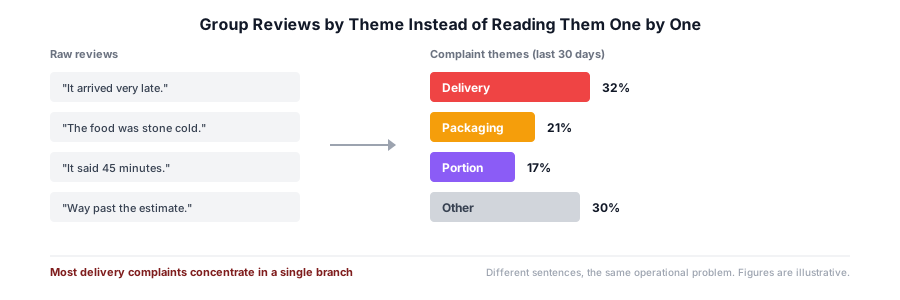
And customers describe the same problem in sentences that resemble each other not at all:
- "It arrived very late."
- "The food was stone cold."
- "It said 45 minutes and took far longer."
- "Way past the estimate."
Four different sentences. One operational problem: delivery.
Group reviews under themes instead of reading them one by one and the picture becomes usable:
A workable theme set usually covers:
- Delivery time
- Packaging
- Portion and value perception
- Food quality
- Order accuracy
- Price
- Promotions and vouchers
- Staff and courier behaviour
If a third of the last 30 days' negative reviews fall under delivery, where the operations team should start next week is not up for debate.
One-Off Incident or Systemic Problem?
Not every negative review is evidence of a problem. Three tests separate the two:
Frequency. How many times has the same theme recurred in the last 30 days? One packaging complaint is noise; twelve is a signal.
Concentration. Are complaints spread evenly across branches, or clustered in specific locations? If most delivery complaints come from a single branch, the problem is not in the recipe — it is in that branch's operation.
Timing. Did complaints start after a particular date? Does that date coincide with a menu change, a supplier switch, a new courier model or a shift reorganisation?
Read together, the three turn an unmanageable statement like "customers aren't happy" into an actionable one: "packaging complaints at the Bakırköy branch tripled after 12 August."
Theme Analysis Without a Branch Breakdown Is Half-Finished
A brand-wide theme distribution is the first step, but on its own it misleads.
Suppose 30% of your negative reviews brand-wide sit under delivery. What do you do with that? Telling every branch to "speed up delivery" is not an action.
Read the same data broken down by branch and the picture changes: the bulk of those delivery complaints may sit in three locations. What do those three have in common? The same zone? The same courier model? The same time of day?
None of that is visible in a brand average. We cover why channel and location have to be modelled together in delivery platform intelligence.
Can a Negative Review Be Removed?
This is one of the most searched questions among restaurant managers.
Platform policy is generally consistent on the point. Under Yemeksepeti's review guidelines, reviews are assessed not on whether they are positive or negative but on whether they meet the publication criteria. Content involving insults, threats, hate speech, personal data violations, advertising or redirection to other sites can be rejected or removed.
In other words, a review being unfavourable to you is not on its own grounds for removal.
The practical consequence: removal is a mechanism that works for reviews breaching the rules. It is not a general reputation tool. Energy spent there pays back far less, over any meaningful horizon, than energy spent preventing the same complaint from recurring.
Who Should Run the Response Operation?
In multi-branch businesses this question usually goes unasked, and replying becomes a task nobody owns.
Two models work:
Central replies. One team answers reviews for every branch. The tone stays consistent and brand voice is protected. The weakness: whoever writes the reply does not know the detail of the incident, so replies drift toward the generic.
Branch replies, central template. The branch writes, the centre sets templates and hard limits. The detail is accurate, but consistency needs supervision.
Whichever model you pick, three things need to be defined:
- A response-time target. How many hours after a review lands should a reply be written?
- An escalation threshold. At what point is a reply insufficient and operations must be alerted? For example: three complaints on the same theme at the same branch within three days.
- What does not get answered. Reviews breaching platform rules go through a removal request; they do not get argued with.
The second item is the critical one. The real output of a response operation is not the text that gets written — it is the alert it sends to operations.
What to Track
Average rating alone does not measure review management. A meaningful set looks like this:
Response metrics
- Share of reviews answered
- Average response time
- Unanswered reviews by branch
Diagnostic metrics
- Theme distribution (last 7 / 30 days)
- Change in each theme versus the prior period
- Theme concentration by branch
- Complaint count by menu item
Outcome metrics
- Rating change (7 and 30 days)
- Change in the share of negative reviews
- Whether complaints fell in the theme you acted on
That last one is the most commonly skipped. If you are not measuring whether complaints in a theme actually fell after you intervened, you do not know whether what you did worked.
See Reviews by Branch and by Theme
The whole diagnostic layer in this article depends on one thing: reviews being collected regularly and made classifiable.
Senkrondata food delivery intelligence builds that layer:
- Review collection by branch and platform
- Classification into complaint themes
- Change over time, broken down by theme and branch
- Competitor review and rating trends
- Alerts when defined thresholds are crossed
Because the data comes from the app itself, the picture matches what the customer sees; we describe the method in how mobile app scraping works. If the rating has already fallen, our guide to improving restaurant ratings covers recovery; to measure satisfaction using sources beyond reviews, see measuring restaurant customer satisfaction.
With Senkrondata you can:
- See reviews broken down by theme and branch
- Catch recurring complaints early
- Measure whether complaints fell after you acted
- Track competitor review trends
Frequently Asked Questions
Does replying to bad reviews raise your rating?
Responding has a measured effect, but a modest one. In Proserpio and Zervas's hotel-sector study, businesses that began responding saw roughly a 0.12-star increase in average rating. That gain is real, but it will not on its own recover a rating that has fallen; the substantial lever is fixing the recurring complaint operationally.
How quickly should I reply to a negative review?
There is no fixed platform rule, but a late reply loses its function. Replying within the same day is a reasonable target for most businesses. What matters more than any individual response time is having a defined target and tracking it by branch.
How do you write a reply to a bad review?
An effective reply is short and has four parts: acknowledge the specific problem, take responsibility, name the concrete step you took, and move compensation to a private channel if needed. Avoid copy-paste text, avoid arguing the facts, and never include personal data in a public reply.
Who actually reads the reply?
The overwhelming majority of readers are not the complainant — they are prospective customers evaluating your restaurant before ordering. The tone should therefore be built around showing a third reader that the problem is managed, not around winning over the complainant.
Can negative reviews be removed?
Under Yemeksepeti's review guidelines, reviews are assessed on whether they meet publication criteria rather than on whether they are favourable. Insults, threats, hate speech, personal data violations and advertising can be removed. A review being unfavourable to the business is not on its own grounds for removal.
How should I categorise reviews?
Delivery time, packaging, portion and value perception, food quality, order accuracy, price, promotions, and staff or courier behaviour is a sufficient theme set for most restaurants. The value comes from reading those themes broken down by branch and over time; a brand-wide distribution alone does not produce an action.
How do I tell whether a complaint is systemic?
Apply three tests together: how often the theme recurred in the last 30 days, whether complaints cluster in particular branches, and whether they started after a specific date. Read together, they usually narrow the cause down to a single branch, menu item or change.
Where this fits in the platform

Co-Founder & CEO
Okan Bircan is the Co-Founder & CEO of Senkrondata, leading data-driven growth for enterprises across e-commerce and price intelligence.
Contact Us
Leave your email address for a detailed demo or overview session, and we will get back to you shortly.