
Category: Analytics
From Reviews to Insight: Building Delivery Platform Intelligence
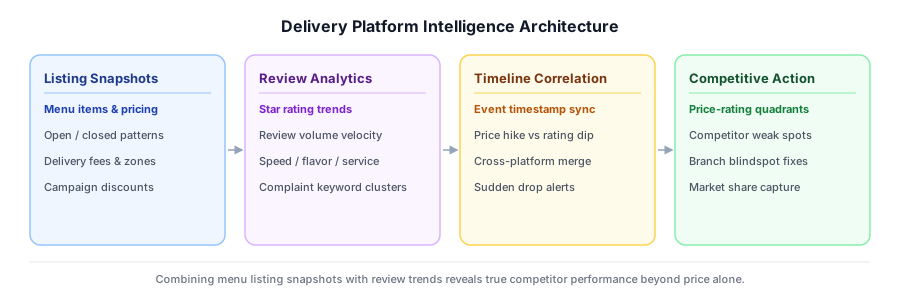
How is delivery platform intelligence built? Real performance is about more than price — we explain how Senkrondata turns listing and review data into insight.
Table of Contents5
Competition on a food delivery platform takes a different shape than grocery or fashion e-commerce. What you're comparing isn't just a product price — it's a menu, a listing, and a pile of reviews and ratings that directly sway a customer's decision. Carrying price-tracking logic over here as-is means missing this channel's most valuable signal: reputation.
Two kinds of data, two kinds of meaning
Delivery platform intelligence rests on two separate data layers:
- Listing data: menu items, prices, delivery fee/time, whether it's currently open or closed, which neighborhoods it serves. This answers "what is the competitor selling, at what price, how fast."
- Review/rating data: customer ratings, review text, review volume and how it changes over time. This answers "what does the customer actually think" — which, independent of price, is a factor that directly drives conversion.
Both layers are observed repeatedly over time and accumulated as snapshots — just like with price history, it's not a single observation but the time series that carries the real value.
What the snapshots reveal over time
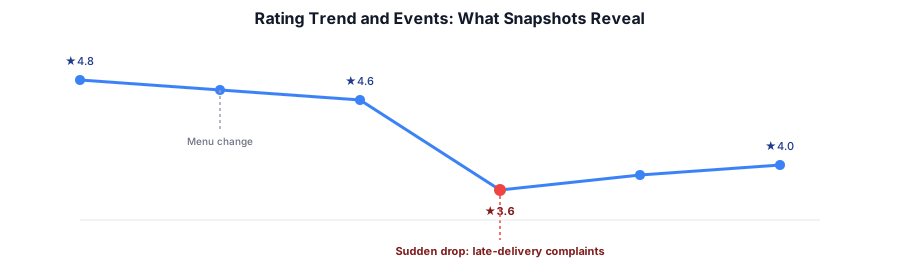
- Rating trend: is a restaurant's rating rising or falling? A sudden drop can point to an operational problem (late delivery, quality issue) — and that can be a moment when the competitor is weak.
- Review volume as a demand proxy. A rise or fall in review count is an indirect proxy for order volume changes — even without direct sales data.
- Menu changes: an item dropped from the menu, a new category added, a price adjusted — these are traces of the competitor's strategic moves.
- Open/closed patterns: at which hours/days does a restaurant appear closed? This tells you something about capacity or operating hours.
From price to insight: why they must be read together
Tracking review and listing data separately gives an incomplete picture. The real value is in bringing the two together:
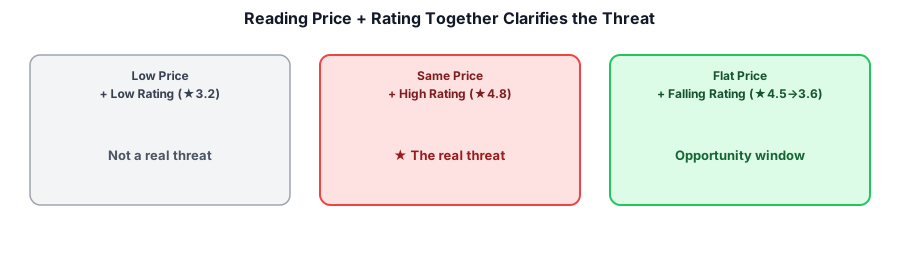
- A competitor with a low price but also a low rating isn't a real threat — it means the customer isn't trading quality for price.
- A competitor at the same price as you but with a noticeably higher rating is the real competitive threat — because the customer perceives a better experience at the same price.
- A competitor whose rating is dropping but whose price stays flat can open a short-term opportunity window.
The principles that keep it trustworthy
- Review data is also stored as raw text. Keeping only the average rating leaves "why" unanswered; the text reveals what complaints are piling up about (delivery, quality, packaging).
- A momentary rating can mislead. A rating built on few reviews is noisy; trend and volume are assessed together.
- Listing and review data are matched to the same time window. To see a price change's effect on rating, the two need aligned timestamps.
The bottom line
Competition on delivery platforms isn't just a price table — it's a whole formed together by menu, price, delivery conditions, and customer perception (reviews). Accumulating listing and review data as snapshots over time and reading them together lets you see not just what a competitor sells, but how it's actually performing.
Three places to start connecting that data to operations: how to increase orders on delivery platforms, managing negative reviews on delivery apps and measuring restaurant customer satisfaction. For a location that has not opened yet, see launching on a food delivery marketplace.
If you want to see competition on delivery platforms beyond just price, talk to the Senkrondata team.
Where this fits in the platform
Price Intelligence & Data Engineering
Emre writes about the machinery behind competitor price data: product matching, normalization, collection at scale and the analytics layer on top.
Contact Us
Leave your email address for a detailed demo or overview session, and we will get back to you shortly.