
Category: Analytics
How to Launch a Restaurant on a Food Delivery Marketplace
A practical guide to opening a store on a food delivery platform: the application, the courier model decision, category choice, and what to measure first.
Table of Contents20
Signing up for a food delivery marketplace takes less time than most restaurant operators expect. The application form is usually a single page, and filling it in takes a few minutes.
The application is not the hard part.
The hard part is this: three or four of the answers you give on that form determine the unit economics and the visibility you will live with for months after you open.
Who delivers the order, which cuisine category you get listed under, which neighbourhoods you serve — these look like form fields. Each one is a business decision.
This article walks through the process. But mostly it walks through what you should look at before you fill the form in.
The Application: What the Platform Actually Asks For
Marketplaces differ in detail, but the first step of the application is consistent across them. Taking Trendyol Go's partner portal as a worked example, the opening form asks for:
- Location — province, district and neighbourhood, selected in that order
- Company type — sole proprietorship through to joint-stock company, chosen from a fixed list
- Tax identification number — the only official record required at this stage
- Restaurant name and legal company name — two separate fields, and they are used differently
- Cuisine type — a single choice from a list of around twenty-six categories
- Contact details — mobile number and email
Note what is not asked for up front. Tax certificates, operating permits and the partnership contract come later, once the application moves into review. Third-party guides that front-load a long document checklist tend to be describing a later stage of the process, or an older version of it.
Two details worth carrying over to any platform:
The restaurant name and the legal name are not the same field. Customers see the restaurant name in the app. The legal name drives invoicing and the contract. Getting these crossed creates reconciliation problems that surface months later.
Quick-commerce and grocery partnerships usually run through a separate application. If you operate both a restaurant and a convenience format, they are two onboarding flows, not one.
The Courier Model Is the Most Expensive Decision You Make
Every marketplace offers some version of the same two choices:
- Your own couriers — you handle dispatch
- Platform couriers — the marketplace's fleet carries the order
The commission rate differs between the two. We are deliberately not quoting rates here. Commission structures change by period, by market and by the terms of your specific partnership, and the figures circulating on third-party blogs are frequently out of date. The rate that governs you is the one in the contract you are sent.
In any case, the commission rate is the wrong number to optimise. What matters is the total cost difference between the two models:
| Your own couriers | Platform couriers |
|---|---|
| Lower commission | Higher commission |
| Wages, vehicles, fuel, insurance and maintenance are yours | No fixed dispatch cost |
| Delivery time under your control | Delivery time depends on the platform's operation |
| Peak-hour capacity is your problem | Peak-hour capacity comes from a shared pool |
| Cost stays fixed when volume is low | Cost scales with volume |
The calculation that settles it is a break-even one. Estimate your monthly order count, put the total cost of both models side by side, and find the volume at which they meet. Below that threshold the platform fleet is usually cheaper; above it, running your own becomes competitive.
Most newly opened restaurants sit below the threshold for the first few months. Starting on the platform fleet and revisiting the decision once volume settles is a common and defensible sequence.
Category Choice Is a Visibility Decision, Not Paperwork
The cuisine category field is usually a single selection, and it determines which category lists you appear in.
Consider a döner shop that also sells tantuni. Pick the larger category and you appear in front of everyone browsing it. Pick the narrower one and you enter a much smaller list — with far fewer competitors.
The right question is not which category has more demand but: which category will I actually be visible in?
Those are different questions. A high-demand category with thirty competitors in your delivery zone will bury a new restaurant with no ratings yet. Ranking third in a list of five often produces more orders than ranking thirty-fifth in a list of forty.
This is answerable with data rather than instinct: count how many restaurants are listed in each category inside your delivery radius, and look at their ratings and price bands.
Before You Submit: Read Your Delivery Zone
Most advice on this topic opens with "take professional photos and write appealing descriptions." That is fine advice, and it answers none of the decisions above.
The questions worth answering before you open are these:
- How many restaurants in my delivery zone are listed under the same cuisine category?
- What does their rating distribution look like — is the average 4.6, or 4.1?
- Where do their menu prices cluster?
- Which promotions do the highest-volume restaurants keep permanently switched on?
- How many competitors show as closed, and in which time windows?
That last question is often the most valuable. If only three restaurants in a zone stay open past 11pm, that is a real entry opportunity for an operator with late-night capacity — and no generic guide can tell you, because the answer is specific to the zone.
The same logic applies to price. Read competitor price and rating together and four distinct scenarios emerge, each calling for a different launch strategy:
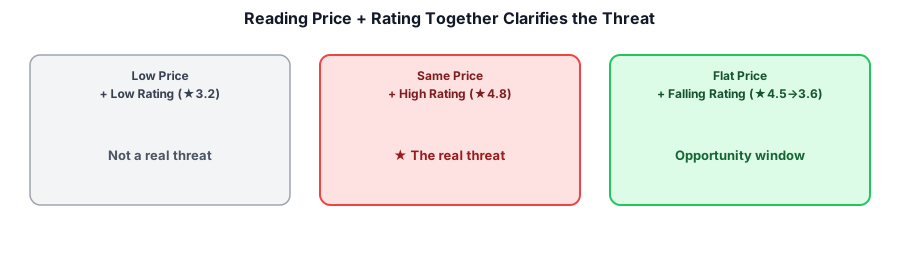
A competitor who undercuts you but carries a poor rating is not your real problem. The competitor sitting at your price with a better rating is. As a new restaurant with no rating history yet, you need an answer to that second group — and price is rarely the right one.
The Senkrondata food delivery intelligence platform produces this picture per zone: competitor ratings, menu prices and active promotions inside the same delivery area, compared on one screen.
Set Your Price Band From the Market, Not From Your Cost Sheet
The most common mistake in menu setup is pricing upward from cost. Cost sets your floor. Your price is set by the alternatives the customer sees on the same screen.
The customer cannot see your cost base. They see ten restaurants listed side by side, and their prices.
So collect three things before you build the menu:
- The price range of your anchor item in the zone — the lowest, median and highest price for the dish you expect to sell most of.
- The price of basket completers — drinks, sides, sauces, dessert. These set your average basket, not the anchor item.
- Minimum basket thresholds. If competitors sit at one level and you set yours materially higher, you are filtered out before the customer ever sees your menu.
Placing your prices is not the end of it. Competitors move prices, open promotions and close them again. A position that was correct at launch can be wrong three months later. We cover how to read competitor price movement over time in turning competitor data into pricing action.
Promotions carry a related trap. Platforms offer discount mechanics that reliably generate orders — but not every discount is a real one. When you benchmark competitor promotions, you need to separate genuine discounts from cosmetic ones.
The First 90 Days: What to Measure
After opening, most operators watch daily order count and little else. That number tells you something is wrong. It does not tell you what.
Three phases work better.
Days 1–30: is the operation stable?
The goal in this phase is not revenue. It is consistency.
- Gap between estimated and actual preparation time
- Rate of missing and incorrect orders
- Hours spent forced-closed because capacity ran out
- The content of the first reviews
Days 30–60: is the positioning right?
Once operations settle, measure your place in the zone.
- Your average rank in the category listing
- Your rating gap against competitors
- Your average basket against the zone average
- The order difference between promoted and un-promoted days
Days 60–90: is the model sustainable?
Now revisit the courier decision.
- Did your actual monthly order count cross the break-even threshold?
- What is your repeat customer rate?
- Which themes do complaints cluster under?
- Which menu items generate refunds and complaints?
At the end of the third month you are working from data rather than projections. Revise the courier model, the menu and the price band against it.
A New Restaurant's Most Fragile Asset Is Its First Reviews
The biggest disadvantage of a newly opened store is that it has no rating yet.
That disadvantage is arithmetic. When the review count is low, a single poor rating drags the average down hard. One 1-star review on a restaurant with five reviews moves the average as much as a hundred 1-star reviews on a restaurant with five hundred.
The practical consequence: the opening weeks are not the time to run your kitchen at the edge of its capacity.
The classic failure is launching with an aggressive discount that pushes demand past what the kitchen can absorb. Orders arrive, preparation slips, food goes out cold, and the first reviews are permanently damaged. Recovery takes months.
How you handle those first reviews, and how you separate recurring complaints from one-off incidents, is its own subject — we cover it in managing negative reviews on delivery apps. If the rating has already fallen, our guide to improving restaurant ratings sets out a fuller recovery path.
One Platform or Several?
Most restaurants start on one marketplace and add a second later. That order makes sense: settling an operation on one channel is easier than learning two at once.
Adding the second channel creates a new problem, though. The same location ends up with different prices, different ratings and different promotion terms on each platform.
Updating a menu on one platform and forgetting the other, creating an unintended price gap between channels, missing that a rating is sliding on one channel while holding steady on the other — all of this is extremely common.
With one location it stays manageable. At five locations across two platforms you are tracking ten separate pages, and manual checking stops being meaningful. What you measure changes too; we explain why channel and location have to be modelled together in delivery platform intelligence.
Track Your Zone From One Dashboard
The application is a one-off task. The real work starts after you open: continuously knowing who changed prices in your zone, who opened a promotion, whose rating slipped.
Senkrondata food delivery intelligence brings together, across the delivery marketplaces you operate on:
- Your own and competitor ratings
- Menu prices and price movements
- Active promotions
- Customer reviews and complaint themes
- Competitive density by zone
Because the data is collected from the app itself, the picture matches what the customer actually sees — we describe how that works in how mobile app scraping works.
With Senkrondata you can:
- Map your zone's competitive landscape before you open
- Position menu prices against the real competitor band
- Catch rating and review shifts early
- See competitor promotions as they go live
Frequently Asked Questions
What does a food delivery marketplace ask for in the application?
The first step typically asks for your location down to neighbourhood level, company type, tax identification number, restaurant name, legal company name, cuisine category and contact details. Official documents such as tax certificates and operating permits are generally requested later, once the application enters review.
Should I use my own couriers or the platform's fleet?
The two models carry different commission rates. Running your own couriers lowers the commission but transfers wages, vehicles, fuel and insurance to you. At low order volumes the platform fleet is usually cheaper; as volume grows, your own fleet can become competitive. Decide it by calculating the order volume at which the total cost of both models is equal.
What commission will I pay?
Commission depends on the courier model you choose and the terms of your partnership, and it varies by market and by period. Figures published on third-party sites go out of date quickly. Verify the rate that applies to you from your contract and your seller panel only.
How should I choose my cuisine category?
The category determines which lists you appear in, and it is not always easy to change later. Before choosing, count the restaurants listed under each category in your delivery zone and look at their ratings. The category with the most demand is not necessarily the category where a new restaurant will be most visible.
What should I measure in the first month?
Measure consistency rather than revenue: the gap between estimated and actual preparation time, the rate of missing or incorrect orders, hours lost to forced closure, and the content of your first reviews. Move to positioning and competitive metrics from the second month onward.
Why do the first reviews matter so much?
When the total review count is low, each individual rating carries disproportionate weight in the average. A single poor review early on can take months to dilute. This is why launching with a promotion that overwhelms kitchen capacity is a costly mistake.
Should I launch on more than one platform at once?
Starting on one channel and adding the second after the operation stabilises is usually the lower-risk sequence. Once you are on two, prices, menus, ratings and promotions must be kept consistent across both, which is where central monitoring starts to pay for itself.
Where this fits in the platform

Co-Founder & CEO
Okan Bircan is the Co-Founder & CEO of Senkrondata, leading data-driven growth for enterprises across e-commerce and price intelligence.
Contact Us
Leave your email address for a detailed demo or overview session, and we will get back to you shortly.